General meaning
⌄
A strong attachment evolves into a long-term source of tension.
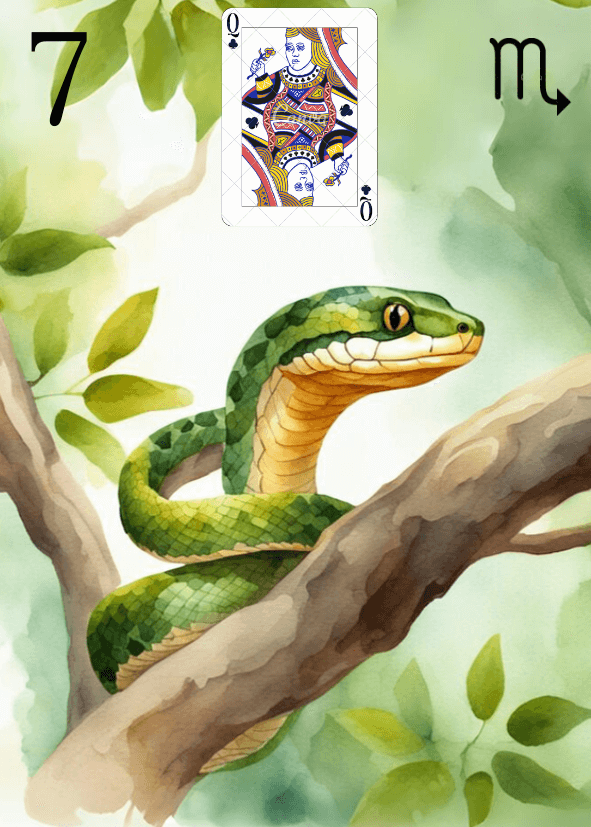
Snake points to an uncomfortable dynamic characterized by mistrust, jealousy, or a constant underlying malaise. Paired with Anchor, it indicates that this tension is not temporary; it has become entrenched in the foundations. The situation persists, sometimes even appearing solid from the outside, but it rests on a type of attachment that obstructs any healthy evolution. You remain tied to something that provides as much reassurance as it gradually poisons you.
Love and relationships
⌄
An emotional bond endures despite evident toxicity.
In matters of love, this combination suggests a long-standing relationship that seems stable on the surface yet is riddled with jealousy, suspicion, or intense emotional dependence. Snake alludes to psychological games, rivalry, or unresolved tensions, while Anchor illustrates the difficulty of leaving. You stay out of fear of losing your reference points, comfort, or status, even though your heart no longer feels genuinely safe there.
Work and vocation
⌄
A stable position becomes a source of moral exhaustion.
In the workplace, Anchor represents a job, status, or role that has been established for a long time. Snake reveals the internal tensions: rivalry, manipulation, a toxic environment, or a complicated relationship with a boss or colleague. Stability hinders decision-making. Leaving feels too risky, while staying becomes increasingly burdensome. This combination often describes a gradual descent into a framework that no longer nourishes you.
Money and material security
⌄
Financial security fosters an uncomfortable form of dependence.
Financially, this pairing can indicate a stable income source that is linked to a toxic situation. It may involve financial support, a contract, or an arrangement that keeps you materially secure while maintaining pressure or implicit coercion. Snake illustrates that money is intertwined with control issues, while Anchor clarifies why it is so challenging to sever the connection.
Health and energy
⌄
Chronic tension settles in over time.
This combination can signify latent stress that becomes ingrained in the body. Snake evokes nervousness, overthinking, or mental tension, and Anchor shows how this state becomes chronic. Issues with the stomach, muscles, or the nervous system may arise when you feel trapped in a situation you do not dare to question.
Objects
⌄
Material items symbolize the binding attachment.
- A contract or commitment that is difficult to break
- An object associated with a job or relationship that has become burdensome
- A key, badge, or tool symbolizing a long-term obligation
Places
⌄
A familiar place is imbued with invisible heaviness.
A workplace, home, office, or long-frequented space where you feel both secure and trapped. Anchor refers to a fixed point, while Snake suggests that the atmosphere has become tense, filled with unspoken issues and accumulated fatigue.
Personality
⌄
Someone who clings on even while feeling unwell.
This profile describes a persevering, loyal individual who is sometimes excessively attached to what is familiar. Snake indicates partial awareness of what is wrong, but Anchor prevents them from letting go. This person may appear mistrustful and defensive, yet remains stuck in a situation that gradually weakens them.
Profession
⌄
A stable role exposed to internal tensions.
- A long-time employee within a rigid structure
- A manager caught between hierarchy and conflict
- A position built on loyalty and endurance
Archetype
⌄
The poisoned anchor.
This archetype embodies the challenge of detaching from what is known, even when it is harmful. It speaks of loyalty taken to such an extent that it becomes self-sabotage, and invites you to question where stability has transformed into a chain.
Shadow work
⌄
Confusing safety with imprisonment.
In its shadow, this combination compels you to stay out of fear of emptiness, change, or instability. You tolerate the intolerable because Anchor soothes your fears. Over time, this erodes self-worth and deepens the feeling of being trapped.
Calibration questions
⌄
An attachment is calling for examination.
- What truly keeps you in this situation?
- What fear lies behind your reluctance to let go?
- At what point does stability become toxic for you?