General meaning
⌄
The collective becomes a trial: social presence weighs heavily, and one feels the burden of obligations.
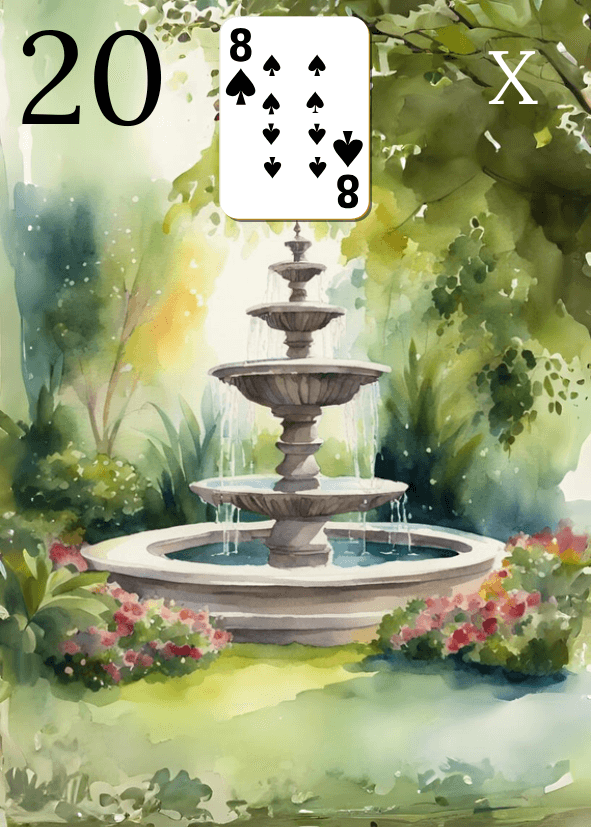
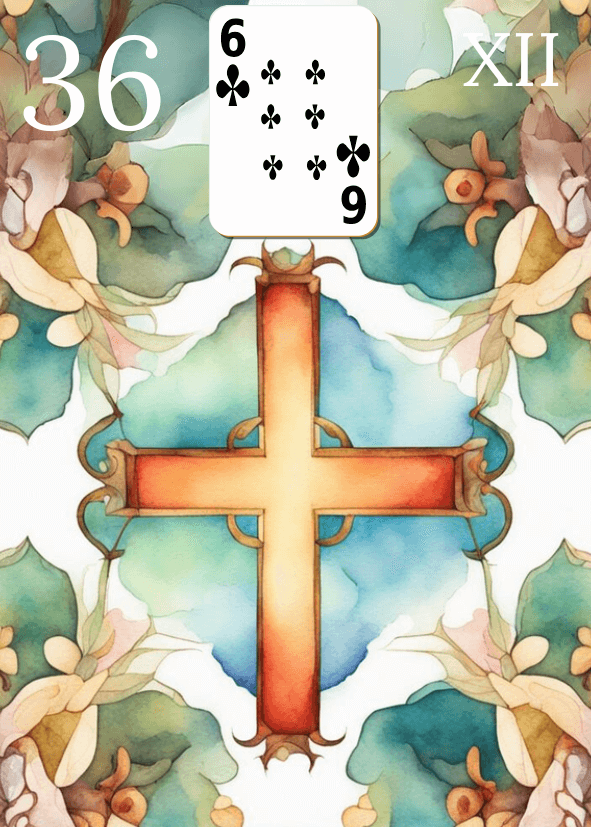
The Garden represents social life, networks, public spaces, and exposure to the gaze of others. The Cross, in the second position, adds a notion of burden, duty, sorrow, and sometimes fatality or emotional responsibility. Together, these cards convey a context where the social is not light: there may be an obligation, a difficult event, a role to play, or a heavy collective atmosphere. One may also feel social pressure, as if one must measure up, maintain dignity, and persevere. This combination invites recognition of the burden for what it is, not to minimize it, and to seek a supportive framework rather than a circle that demands.
Love and relationships
⌄
The relationship is influenced by an external weight: family, social gaze, obligations, or guilt.
In love, the Garden followed by the Cross can indicate that a couple is experiencing a heavy phase, often due to the weight of the social context: family pressure, expectations from those around them, conflict within a shared circle, or a feeling of having to carry something together. It can also reflect guilt, sadness, or a bond that is lived under the scrutiny of others, accompanied by a sense of trial. For a single person, the combination may signal a hindrance: a recent sorrow, grief, or a period when one lacks the energy to reach out to the world. The message is not to force, but to choose environments that support rather than those that judge.
Work and vocation
⌄
Professional life imposes a visible burden: responsibilities, pressure of reputation, collective duties.
At work, this pair can evoke a heavy responsibility in a collective setting: holding a difficult position, managing a team crisis, carrying a burdensome project, or enduring a period where one must remain present despite fatigue. The Garden emphasizes the public dimension: one is seen, evaluated, and may feel pressure regarding reputation. The Cross highlights endurance and duty. This combination invites clarification of what truly falls under your responsibility, to seek support if necessary, and to avoid carrying alone what should be shared.
Money and material security
⌄
Financial obligations weigh heavily, sometimes linked to a group, family, or social commitments.
On a material level, the Garden and the Cross can indicate mandatory expenses related to social life: events, commitments, contributions, shared costs, or family responsibilities. It can also reflect social pressure surrounding money, as if one must maintain an image, keep up with a pace, or participate in something despite a tight budget. The combination invites a reassessment: what is truly necessary, and what falls under an implicit obligation? Adjusting the framework can alleviate much.
Health and energy
⌄
Fatigue increases when one carries too much, especially under the gaze of others or in a demanding social setting.
For health, this combination highlights an emotional and mental burden that can manifest physically: exhaustion, heaviness, tension, and a feeling of having to hold on despite everything. The Garden shows that the social environment is a determining factor: too many demands, too much pressure, and too many expectations. The Cross speaks of endurance, but also of overload. The message is to reduce non-essential obligations, to choose a supportive circle, and to allow oneself to recover without guilt. When the body signals to stop, it is not a whim; it is a signal.
Objects
⌄
Objects related to obligations and commitments materialize the collective burden.
- Invitations, summons, or documents related to a mandatory or difficult event
- Files, administrative papers, and forms associated with responsibilities to bear
- Outfits chosen to fulfill a role, such as formal clothing or occasion accessories
- Messages and exchanges that remind one of commitments, duties, or expectations
- Symbolic objects of support, such as a candle, a piece of jewelry, or a sign of remembrance
Places
⌄
Public places associated with duty, weight, and responsibilities become central.
This combination can designate places where one gathers for something serious: ceremonies, institutions, heavy meetings, administrative appointments, contexts where one must stand firm. The Garden speaks of frequented places, while the Cross adds the dimension of gravity. It can also refer to a social space where the atmosphere is heavy, where one feels moral tension, sadness, or implicit expectations. The good guideline is to limit exposure to what drains energy and to prioritize what supports.
Personality
⌄
A person capable of enduring, but who risks carrying too much to preserve the image or peace of the group.
This combination can describe someone responsible, enduring, and very aware of the gaze of others and collective obligations. The person holds their place, assumes responsibilities, and faces challenges. However, they can also exhaust themselves trying to remain impeccable, not to disappoint, and carrying an emotional burden for everyone. They need to learn to ask for support, to set boundaries, and to recognize that dignity does not require constant sacrifice. Endurance is a strength, provided it does not become a prison.
Profession
⌄
Roles where one bears visible responsibility, in service of a collective or an institution.
- Team leader or coordinator during a crisis or tense period
- Professional in administration, social work, or institutional roles, in contact with the public
- Support worker or mediator managing heavy human situations
- Organizer of official events or serious ceremonies
- Jobs where reputation and public duty require constant composure
Archetype
⌄
The silent place after the celebration.
The archetype evokes a place where one gathers, but where laughter is absent. One comes to support, to hold on, and to be present. The Cross speaks of what weighs and what is endured. The Garden reminds us that even trials are experienced in connection, and that solidarity exists if one chooses the right presences. This archetype whispers that there are moments when being seen is not a pleasure, but an act of courage, and that courage also requires gentleness.
Shadow work
⌄
Imposing oneself to bear a painful social role, until confusing dignity with sacrifice.
In its shadow, this combination can push one to remain in circles that judge, that demand, and that impose implicit obligations, out of fear of losing one's place or image. One can also exhaust oneself by being strong, by not showing one's pain, and by carrying everything. The risk is inner isolation: being surrounded yet feeling alone. The way out of this trap consists of recognizing one's limits, reducing non-essential obligations, and choosing connections that truly support, rather than those that always demand more.
Calibration questions
⌄
What do you carry out of duty, and what could you let go of to breathe again?
- What social obligations cost you the most right now, and are they truly necessary?
- Which connections genuinely support you, instead of imposing an image to uphold?
- What clear limit could you set right now to lighten your load without guilt?