House 19: Tower
Who has power or authority here?What is at a distance?
In a Grand Tableau, the House of the Tower draws your attention to two broad ideas: authority and distance.
To read it, look at the card in this House. Then ask yourself what you are trying to understand.
You can ask “Who has power or authority here?” if your situation concerns an administration, a company, a supervisor, or someone who makes decisions.
You can ask “What is at a distance?” if you are trying to understand separation, distance, or a situation where each person stays on their own side.
The card in the House of the Tower then helps you build the answer.
The Tower opens two doors
You do not need to answer both questions in every reading.
If your question concerns work, an institution, rules, or an official decision, start with authority.
If you are trying instead to understand why someone is pulling away, what creates a separation, or what remains inaccessible, start with distance.
Sometimes you will not need to think long. One of the two questions will simply feel more fitting in the context of your reading. Follow that path.
Door 1: who has power or authority here?
The Tower may represent a person or structure with the power to make decisions, set rules, or establish a framework.
Then look at the card in the House of the Tower and ask:
“Who or what has authority in this situation?”
For example, if the Letter is in the House of the Tower, authority may come through a document, a contract, a written decision, or official communication.
The card will not always give you a person's exact name. It may also show the form authority takes.
Door 2: what is at a distance?
The Tower also speaks of what is separated, far away, or kept apart.
This distance may be very concrete. Two people may live far from each other, work in different places, or be physically separated.
But it may be less visible too. Someone may be pulling away, keeping to themselves, or strongly protecting their independence.
Look at the card in this House and ask:
“What is far away or separated here?”
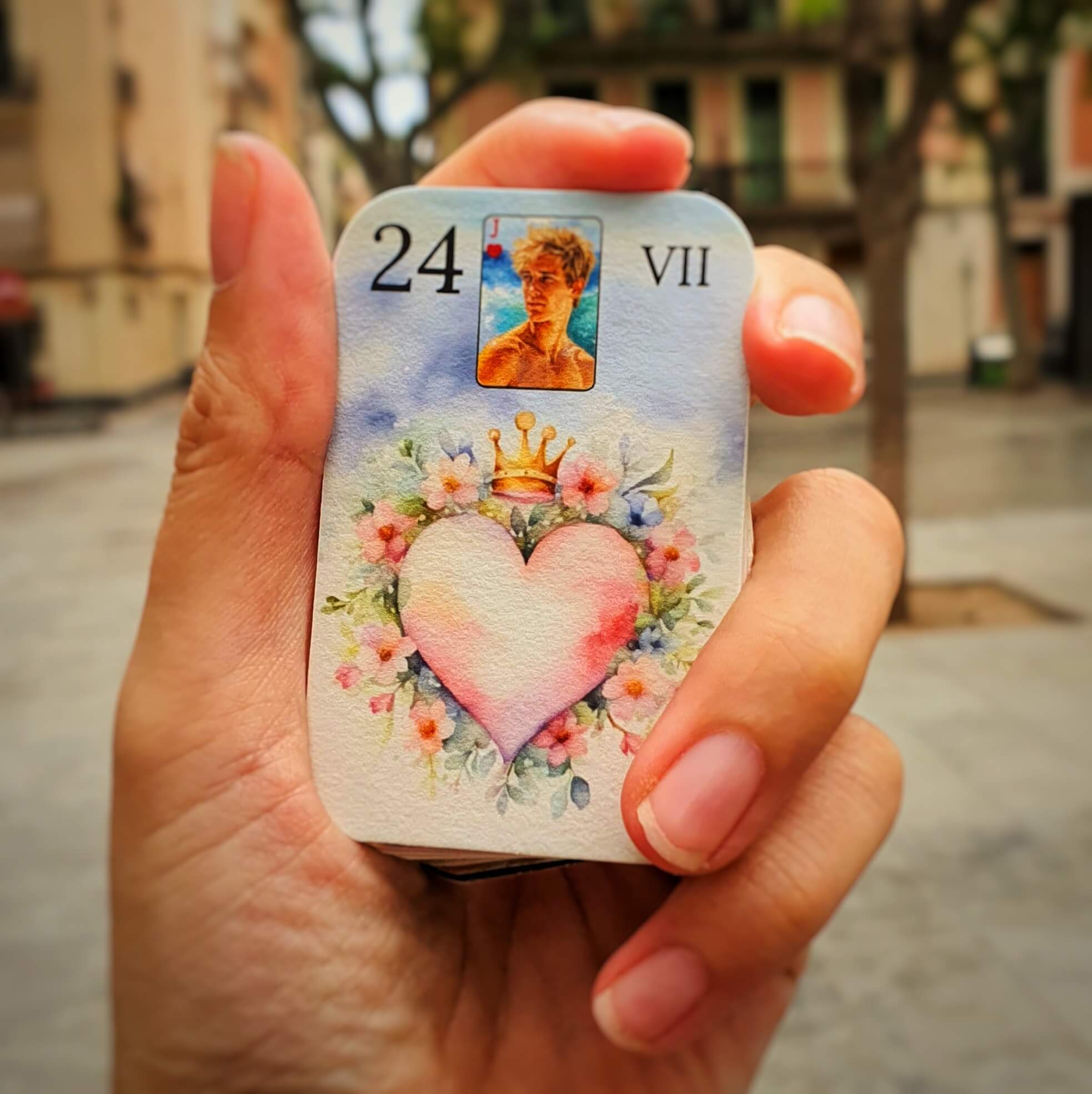
For example, if the Heart is in the House of the Tower, the distance touches the emotional sphere. Depending on the situation, this may point to long-distance love, emotional distance, or someone keeping their feelings at a distance.
The context helps you choose the interpretation that makes the most sense.
A third, quieter question
The Tower may also invite you to step back.
In some situations, you can therefore ask:
“What do I need to look at from a higher vantage point?”
Imagine the Bouquet in the House of the Tower. It may invite you to take a little distance from an invitation, a pleasure, a gift, or something that seems pleasant.
This is not necessarily the first question to use. Keep it in mind when the reading seems to ask you to step away from the situation to see it more clearly.
How do you choose the right question?
You do not need a complicated rule.
Start with the subject of your reading.
If it concerns a company, administration, supervisor, rules, or a decision, try the question of authority first.
If it concerns distance, separation, independence, or someone staying apart, try the question of distance instead.
If neither one really sheds light on the reading, ask whether the Tower is simply inviting you to step back.
The goal is not to force the card into a meaning. It is to find the question that really helps explain what your Grand Tableau is showing.
What if Tower falls in its own House?
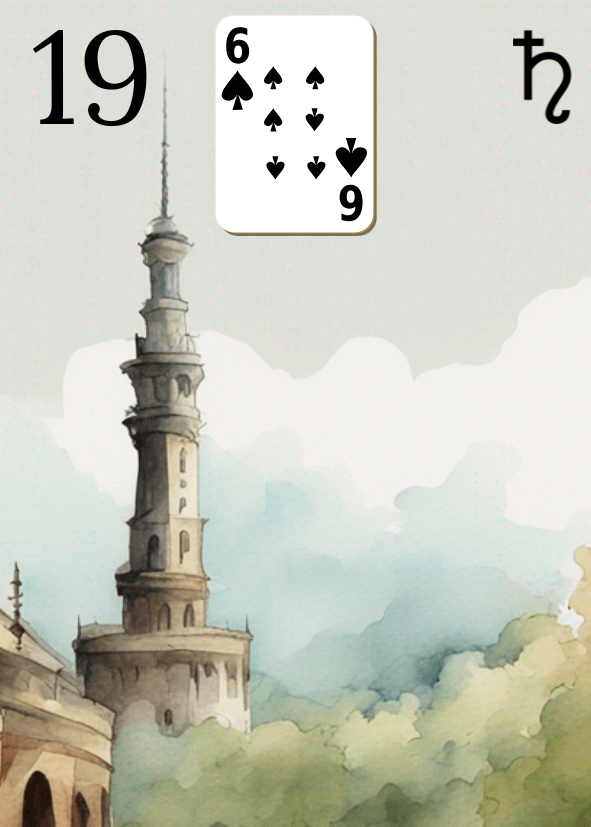
When the Tower falls in the House of the Tower, a solid framework or a marked distance structures the reading. Depending on the subject, an institution, hierarchy, or rule may come to the fore. In another reading, independence, withdrawal, or separation may matter more.
This position may invite you to step back and see the whole picture. It may also show that caution has grown so strong that everything is watched from the tower.
Nearby cards help you distinguish a framework that protects, authority that decides, and distance that confines. This position alone is not enough to predict a crisis or collapse.
Example: the Book in the House of the Tower
Now imagine the Book in the House of the Tower.
With the first door, you ask:
“Who has power or authority here?”
The Book may then draw your attention to knowledge, information not yet available, studies, or something that needs to be discovered before you can understand the situation.
With the second door, you ask:
“What is at a distance?”
The Book may then show information being kept apart, something you do not yet have access to, or knowledge that remains out of reach.
The card is the same. What changes is the question you ask it.
That is the value of Houses in the Grand Tableau: they do not only give cards another layer of meaning. They may also show you which question to ask to see the situation from a new angle.