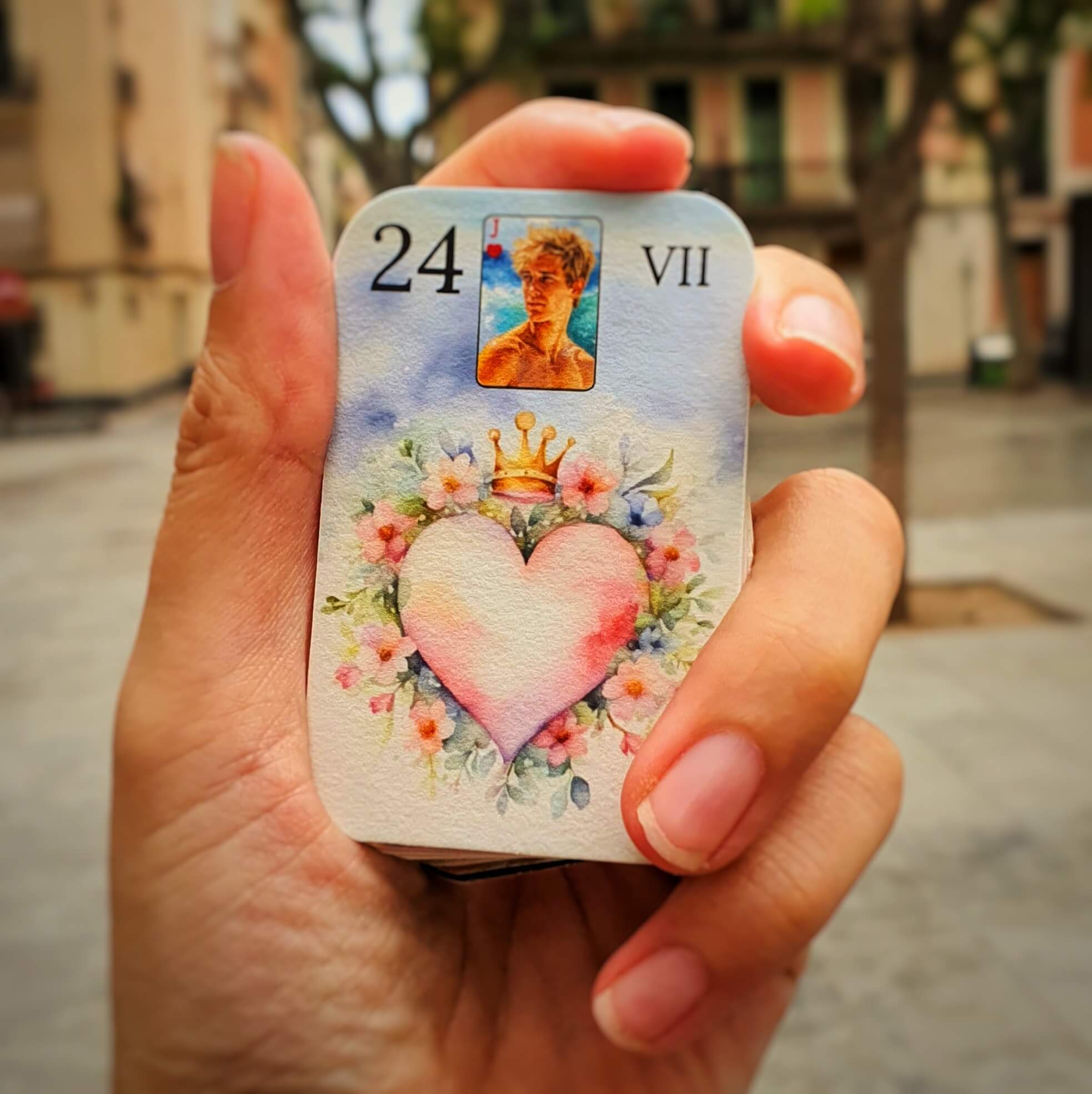
Lenormand bears a French name. Yet to find its pictures before they acquired that name, we need to open a German game box. Inside are thirty-six cards, small French and German suit signs, and an instruction leaflet. Players could arrange these cards into a track and try to reach the space called Hope.
That space was Anchor, number 35. Lenormand kept it, along with Rider, Dog, Letter and many other figures you would recognise at once. Between that board game and today’s readings, however, publishers changed a title, booklets circulated, and cards were sold under the name of a famous fortune-teller who had not created the game.
Lenormand’s direct ancestor is the Game of Hope, Das Spiel der Hoffnung, attributed to Johann Kaspar Hechtel and published in Nuremberg in the late 1790s.1 Lenormand died in 1843.8 The Koblenz advertisements of December 1845 examined below subsequently document cards being marketed under her name.10 The images, the commercial name and the reading methods each have their own chronology.
I love the tangible turns in this story: a board that comes apart, a booklet offering several uses, an advertisement promising a great deal. To follow them, let us begin before the name Lenormand appeared on the boxes.
Before Lenormand: cards for play and fortune-telling
In eighteenth-century Europe, card play and fortune-telling could use the same objects. An ordinary deck did not need new pictures to tell fortunes. What changed was how it was handled, how the cards were arranged and the questions they were asked to answer.
In France, Jean-Baptiste Alliette, known as Etteilla, published in 1770 Etteilla, ou Manière de se récréer avec un jeu de cartes. The book establishes an early reference point: printed cartomancy long predates decks sold as Lenormand. Etteilla later wrote about tarot, whose history as a trump-taking card game had begun in fifteenth-century Italy.2
A whole world of pictures surrounded the cards: emblems with mottoes, lottery figures, shapes to recognise in coffee grounds. A road divides, a dog accompanies, a letter arrives. Such motifs could tell stories of journeys, bonds and news. Their appearance across different media does not necessarily mean one author borrowed them all from a single source.
Printed works show what was offered to readers; they do not record every household practice or fortune-telling session. Historian William G. Pooley’s research, drawing on court cases and manuals among other sources, invites us to look at cards in use: objects handled to discuss relationships, hopes and life’s difficulties.3 It is in this setting that the thirty-six images took a recognisable form.
Hechtel and Bieling: the Game of Hope appears in Nuremberg
Johann Kaspar Hechtel was a Nuremberg game designer who died in 1799. Biographical research also describes him as a merchant and manufacturer. His name accompanies several amusements; the one that concerns us is Das Spiel der Hoffnung, the Game of Hope. The surviving material names G. P. J. Bieling, a publisher in the same city.1
Who invented Lenormand? The most useful answer begins with Hechtel, provided we specify what is attributed to him: the German game from which the classic repertoire descends. Crediting him with every modern reading method would require further evidence.
Books give dates of 1798, 1799 and 1800. These are not three interchangeable answers to one question. A collection by Hechtel, Beiträge zur geselligen Freude, appeared in 1798. Researchers have reported Game of Hope advertisements from that year. An advertisement from 1799 in Humoristische Blätter für Kopf und Herzhas also been identified. Several manuals use 1800.1
The collection, the advertisement and the cards are different pieces of evidence. The 1799 advertisement lists the Game of Hope under Hechtel’s name, with thirty-six coloured cards priced at thirty kreuzers. The 1798 collection is offered separately. This documents a commercial offer, not the day of invention or a box from the very first edition.
In the late 1790s : that is the most defensible reference point for the narrative. More precise dates belong in the notes and timeline. Now let us examine a copy whose physical features we can describe.
The Game of Hope held by the British Museum
The British Museum holds a Game of Hope under accession number 1896,0501.495. Its record describes thirty-six cards and a four-page leaflet, broadly dated to around 1800-1850. The box announces a new edition; the transmitted rules describe a second, improved edition.4
This box is often presented as though it were the original game of 1799. It actually documents a later edition. This is more than attention to small print: if rules could change, the date of the first invention does not automatically date every sentence in the surviving leaflet.
Freeman Marius O’Donoghue’s 1901 catalogue describes the set: pictures, numbers, miniature French and German playing cards, Bieling’s address and instructions. It also lists a similar incomplete deck without a box or rules. Two surviving examples, then, but no reason to call the second a “first edition” merely because its packaging is missing.4
The double suit signs already tell us something. Owners could recognise both French and German suits. The leaflet explicitly offered several amusements. One small box was meant to entertain on more than one evening.
The Game of Hope: thirty-six cards become a board
For the board game, the cards are placed in numerical order in six rows of six. Players need two dice and counters. The leaflet describes payments, movements and spaces where a player must wait. The pictures acquire their roles within these rules.5
Fox sends the player back to number 5. Coffin and Mountain can hold them in place. Landing exactly on Anchor, number 35, wins the game and the pot. Cross, immediately after it, can instead trap the counter. The title makes sense: Hope has an address, and overshooting it is best avoided.
This mechanism changes how we see the cards. The favourable Anchor is not yet floating in a keyword list: it is a destination. Fox is more than an idea of cunning: it creates a detour. Modern meanings may echo these roles, but converting every game effect into a permanently fixed divinatory meaning would be unwise.
The board has a practical feature too: it comes apart. After play, thirty-six spaces become thirty-six cards again, ready to shuffle, deal or use differently. The double playing-card images make ordinary card games possible. The final paragraph of the instructions offers another use.
The surviving leaflet already included an oracle
For the oracular amusement, the deck is shuffled and the person concerned cuts it. The cards are then laid out in five rows: eight, eight, eight, eight, then four. The story begins with Woman or Man and the surrounding images. The text invites the reader to compose an entertaining tale from these encounters.5
The ordered 6 × 6 board and shuffled 8 × 4 + 4 oracle thus serve different purposes. Manuals do not all describe them alike: Caitlín Matthews gives the oracle as 6 × 6, while Marcus Katz and Tali Goodwin’s translation and the German transcription specify four rows of eight, followed by four cards.5
This rules out an overly neat story: a purely recreational game suddenly becoming divinatory decades later. The surviving early leaflet already provides both uses. What we do not have here is a first edition dated 1798 or 1799 guaranteeing that exact wording.
Nor does this short oracle teach the whole modern Grand Tableau. It contains person cards, neighbours and a narrative, but no complete handbook of houses, diagonals or chains. The relationship is interesting precisely because we can describe it without erasing the time between methods.
One game, two layouts
The board game
6 × 6 · numerical order
35: Anchor, the favourable destination
The oracle
8 + 8 + 8 + 8 + 4 · shuffled cards
Reading around the person cards
Earlier symbols: what the coffee grounds reveal
In 2013, Mary K. Greer published a particularly fruitful discovery: thirty-two emblematic cards accompanied by a London booklet dated 1796, Les Amusements des Allemands. It combines coffee-ground reading, cards and numerical amusements. The British Museum holds this set under number 1982,U.4637.1-32.6
Its advertising text says the game came from Vienna, where it had supposedly been all the rage since 1794. That is how two dates enter the story: 1796 belongs to the identified London edition; 1794 is its claim about an earlier Viennese history. Without an examined Viennese copy, each date needs to keep its label.
The 1796 list reported by Greer and the booklet transcription contains several familiar motifs:
| Motif | 1796 sequence | Classic Lenormand |
|---|---|---|
| Ring | 2 | 25 |
| Clover | 3 | 2 |
| Anchor | 4 | 35 |
| Letter | 6 | 27 |
| Dog | 9 | 18 |
| Heart | 24 | 24 |
This table compares motifs and their positions in the sequences. It does not claim six identical drawings or six unchanged meanings. Heart even keeps its number; the other positions are rearranged.
The comparison reveals a stock of images predating Hechtel. It does not identify the copy on his table or list his borrowings. Emblem books and illustrated lotteries, including Biribissi, broaden the possible comparisons. A Biribissi board held by the Lottery Museum and dated around 1800 is an object to examine, not proof that Hechtel copied it.7
Lenormand’s symbols have relatives and neighbours. Giving them all one origin would obscure the variety of trails the documents allow us to follow.
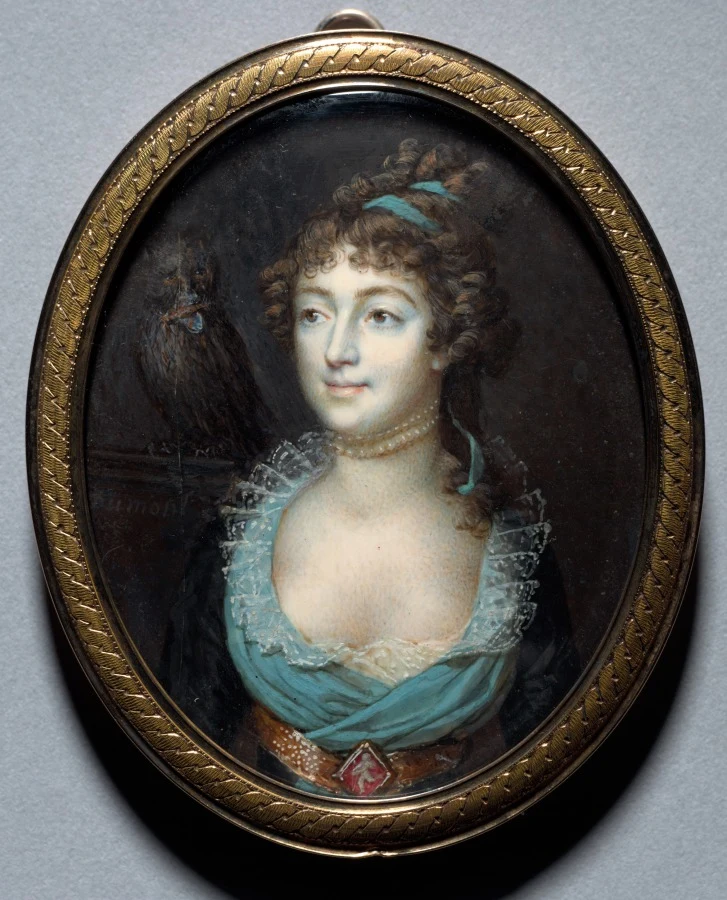
Marie-Anne-Adélaïde Lenormand: publishing a reputation
While these images circulated in German games, another story was unfolding in France. Marie-Anne-Adélaïde Lenormand, often written Le Normand, came from Alençon and worked as a fortune-teller in Paris. French bibliographical authorities generally give 1772-1843 as her lifespan. Older sources give a different birth year; the discrepancy is noted below.8
Her place in the divinatory culture of her time depended as much on stories told about her as on what she printed. She wrote Souvenirs prophétiques d’une sibylle in 1814,Oracles sibyllins in 1817, and Mémoires historiques et secrets de l’impératrice Joséphine in 1820. The titles already announce an engagement with political events and contemporary figures.8
These books need to be read with their dual nature in mind. They recount memories and prophetic claims, while placing their author within the history she narrates. A prediction printed after an event can tell us much about reputation-building without becoming a prediction recorded before it happened.
In 1832, a copy of Manifeste des dieux sur les affaires de France carried a warning against counterfeits: Lenormand approved only volumes bearing her signature. Wellcome’s digitised copy preserves a handwritten one. Her name was already something to protect.8
A document from 1838 records another public stance. In the Gazette des tribunaux, Lenormand responded to a woman described as her pupil. She declared that she had never trained pupils and had no intention of doing so.9 This is her own statement, reported by the newspaper. It cannot tell us about every relationship she had, but it asks us to examine later claims of teaching lineage carefully.
She did not let her name circulate without concern for its use. Her books, warnings and press interventions reveal an author attentive to her public representation. After her death, however, that name would continue its career on very different objects.
A name in circulation, a signature under protection
London, 1826
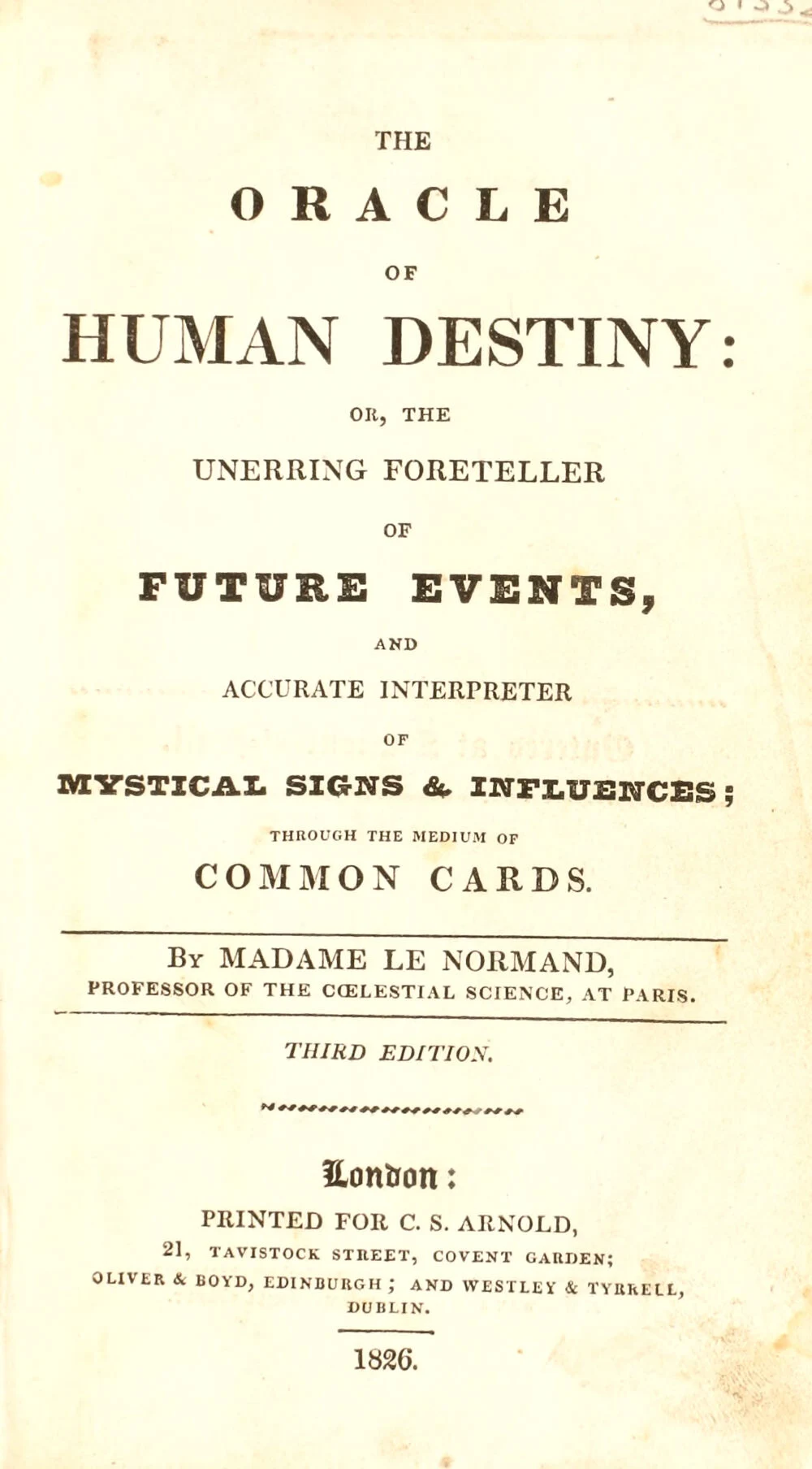
Wellcome Collection, b29337963, image 5 · Public domain (PDM).
Paris, 1832
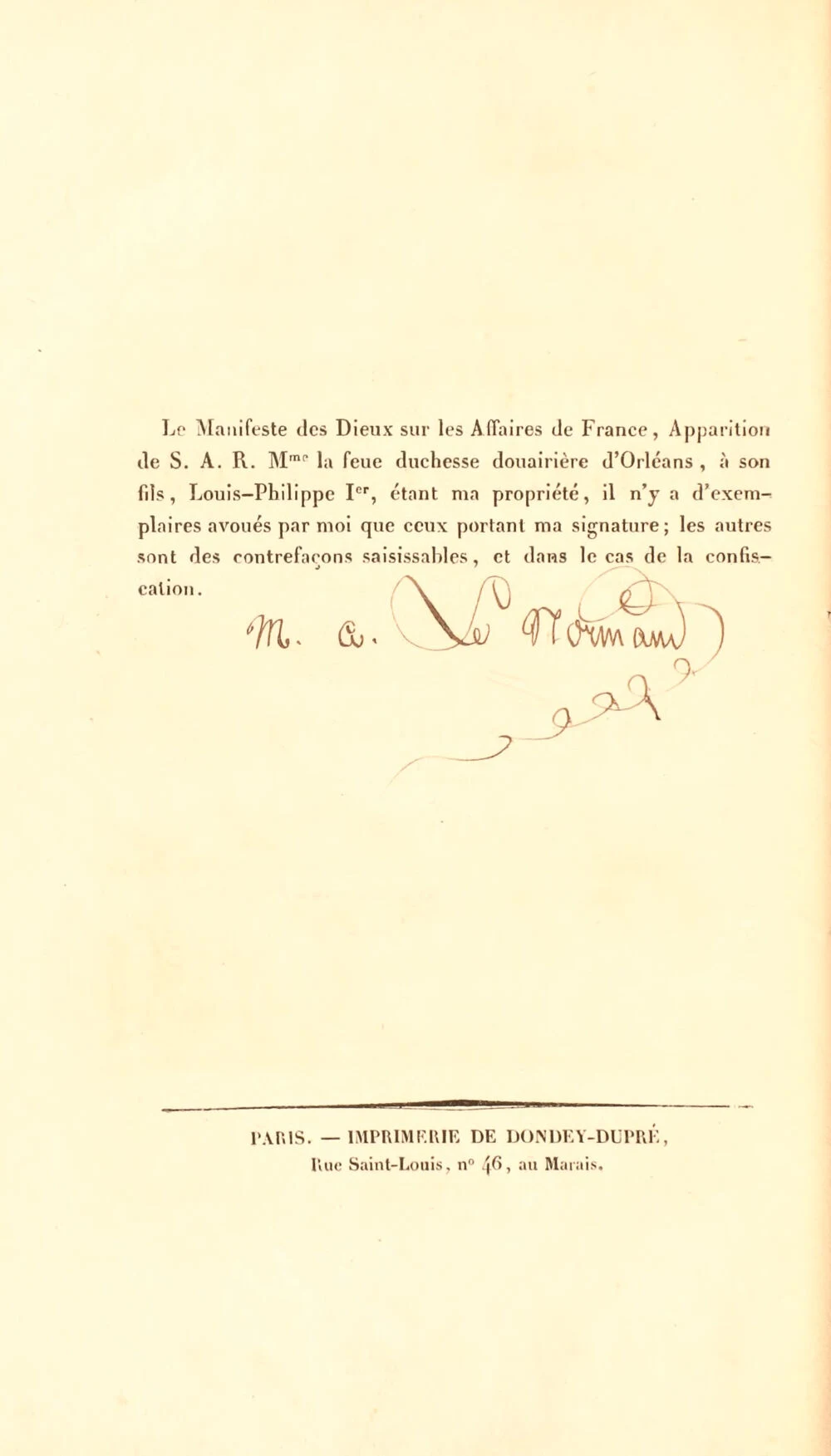
Wellcome Collection, b29304647, image 6 · Public domain (PDM).
Joséphine, Napoleon, Robespierre: fame makes good stories
The best-known anecdotes link Lenormand with Joséphine, Napoleon and Robespierre. They tell of meetings, warnings and foretold destinies. Such stories belong to her fame; treating their events as facts requires knowing who reported them, when, and with what independent testimony.
The Mémoires devoted to Joséphine appeared in 1820, after the empress’s death. They establish that Lenormand wrote about her; the title alone does not establish details of their conversations. Autobiographical accounts and late memoirs can be useful, but their time distance and viewpoint remain part of the evidence.
Among the documents examined for this article, no sufficiently precise independent contemporary evidence confirms the major predictions attributed to Lenormand about Napoleon or Robespierre. That does not prove no meeting ever occurred. The conclusion concerns the narrated episodes: they remain traditions of reputation, not consultations we can reconstruct.
Advertising is easier to grasp. A Koblenz commercial notice identified as 5 December 1845promises cards with which Lenormand supposedly foretold Napoleon’s greatness.10 The sentence does not prove a consultation. It shows what a seller believed would persuade customers. The emperor still had a future in advertising.
Why is it called Lenormand? The Koblenz trail
Lenormand died in 1843. Two years later, her name appeared in the card trade in Koblenz, then often written Coblenz. For a long time, 1846 was used as the reference date for this transition. Research by Greer and documentary exchanges between Helen Riding and Lothar Teikemeier helped bring this German trail to wider attention.10
A study published in September 2026 by Antonella Rotti provides an earlier piece of evidence: an entry in the Börsenblatt für den Deutschen Buchhandel dated 2 December 1845, under Reiff’s Koblenz listing. Item 10029 announces cards of the Parisian fortune-teller Lenormand, edited by Chator, with an explanation. The “32” that follows is a bibliographical format, not a claim that the deck contains thirty-two cards.10
Reproductions of later notices identify a second edition of thirty-six cardsin February 1846, then a fourth in August. They narrow the chronology without giving the day the first box left the workshop. Nor do they identify any surviving box as that inaugural copy.
The fourth-edition announcement adds another important detail. Signed J. B. Rühl, it states that the game is issued by his lithographic establishment. It explains that Reiff had distributed the first three editions and that distribution was passing to Hölscher.10 We can name a producer for this fourth edition and trace a commercial arrangement. Calling Reiff the sole inventor or manufacturer of the entire lineage would run ahead of the documents.
In the December 1845 notice, Chator is described as Lenormand’s heir. The title lends the cards supposed authority. It remains a seller’s claim: a commercial notice is not a probate record. Her name becomes a promise of provenance that can overshadow the images’ German history.
“Philippe, heirs of Mlle Lenormand”: a signature is not proof of kinship
An American leaflet associated with McLoughlin cards bears another signature: Philippe, followed by a reference to Mademoiselle Lenormand’s heirs. The Penn Museum also holds a McLoughlin set of thirty-six cards, box and instructions, dated to 1882-1893.11
The leaflet promises the famous sibyl’s cards and their explanation. It includes meanings, a complete layout and a sample reading: a genuine record of transmission. Its commercial preamble, however, does not demonstrate that Lenormand wrote the method or used those same cards.
Chator and Philippe also need to remain in their respective places. The first appears in the Koblenz notices examined here; the second in a leaflet tradition represented by a later example. Merging them into one person would neatly solve a question the documents do not resolve.
Philippe is often called “fictitious”. What these documents establish is narrower: the signature exists; the biographical identity and claimed lineage are unproven.
Piquet and four added cards: testing an appealing explanation
Another story offers a simple origin: Lenormand supposedly took a thirty-two-card piquet pack and added the four sixes to make thirty-six. The arithmetic works. Attributing the act requires a different kind of evidence.
Comparing two editions of The Essential Lenormandby Rana Georgereveals a change in this account. In 2014, the introduction compares card values with piquet; the glossary defines piquet as a thirty-two-card game. The corresponding passage does not say Lenormand personally added the four sixes. In 2025, the second edition explicitly attributes that act to her.12
The difference matters because it concerns the system’s origins, not just an interpretive preference. The repertoire’s descent from the Game of Hope is supported; no contemporary document checked here establishes the creative act attributed to Lenormand. A practical manual can confidently transmit a tradition without becoming an archive of that invention.
The word piquet itself requires attention to the rules and their period. Learning Lenormand reproduces rules for thirty-six-card piquet in an appendix. This reminds us that historical pack sizes cannot be reduced to one modern definition; it does not prove what Lenormand created.12
Assembling thirty-six cards and designing their sequence of images are two different questions.
Petit and Grand Lenormand: two histories under one name
The Lenormand name appears on several families of decks. The Petit Lenormand has the classic thirty-six figures whose lineage we are tracing. The Grand Lenormand, traditionally comprising fifty-four cards, has much denser compositions: mythological scenes, constellations, flowers and other correspondences share the image.13
The Grand is not the Petit with eighteen extra cards for advanced readers. Their structures differ. Sharing a name instead shows how useful that name was for marketing distinct systems.
In Hoffmann and Kroppenstedt’s 1972 catalogue, the date 1845 concerns the Grand Jeu de société de Mlle Lenormand, according to Antonella Rotti’s precise reading. It therefore cannot date the Petit. The December 1845 commercial evidence discussed above belongs to a separate documentary trail. The two cases must remain distinct: an advertisement for fifty-four cards does not prove the sale of a thirty-six-card deck, or vice versa.13
As for the Grand Tableau, it is a way of laying out the Petit Lenormand cards. “Grand” refers here to the spread’s extent; it does not turn the deck into Grand Lenormand. One word can refer to another deck or a spread: the rest of the name matters.
How reading methods travel and change
The American leaflet signed Philippe offers a useful vantage point. It arranges the thirty-six cards in four rows of eight and a final row of four. Woman and Man serve as reference points. Proximity, distance and sometimes orientation modify the indications given for cards.11
Mountain, for example, plays a different role depending on whether it is near or far from the person. Anchor is also read according to distance. This is more prescriptive than the Game of Hope’s invitation to compose an entertaining story: it gives readers rules to return to.
The comparison traces a change in documents, not every lesson taught between publications. Oral transmission rarely leaves the same evidence as a book sold with a deck; conversely, a surviving booklet does not tell us how every buyer actually used it.
Modern manuals offer other windows. Matthews develops tableaux and playing-card insets; George emphasises context and adds her own developments. Musruck devotes a guide to combinations; Young-Sutton details reading mechanics; Mazza presents a living, personal practice.14 These approaches belong to the deck’s modern reception.
For regional differences, labels are easier to find than complete genealogies. A French book and a Belgian deck do not establish a homogeneous national school. Naming an author, an edition and a specific instruction makes variations genuinely comparable.
German, Belgian and American decks: following travelling objects
Cards travel, but their details give this history stopping points. A small series by Dondorf, held by Einbeck’s Stadtmuseum, shows Ship, Clover, Ring and Rider. Scenes develop within each card while numbers and insets keep common reference points. The museum gives a broad date range; turning it into a precise year would be misleading.15
In Bruges, Geûens-Seaux published a Petit Lenormand held by the BnF and dated between 1895 and 1901 : thirty-six cards and rules. The record locates the responsibility statement on card 27, Letter. A card can carry both a message within the game and an address for its historian.15
Another Belgian example, Garden by Brepols held by Antwerp’s MAS, is catalogued as 1910-1930 and attributed to that publisher. It shows how the same number and subject survive different artistic choices.15
The McLoughlin set published in New York and held by the Penn Museum documents another stage in the deck’s travels in the late nineteenth century. Records, languages, cards and booklets mark intersecting routes rather than one single itinerary.
The classic repertoire is remarkably stable, though not every product bearing the Lenormand name follows it. Manufacturers have changed order, figures or card counts; the 1901 catalogue preserves examples. A recognisable family need not make every member an identical copy.
Two witnesses to the deck’s European travels
Dondorf, Frankfurt
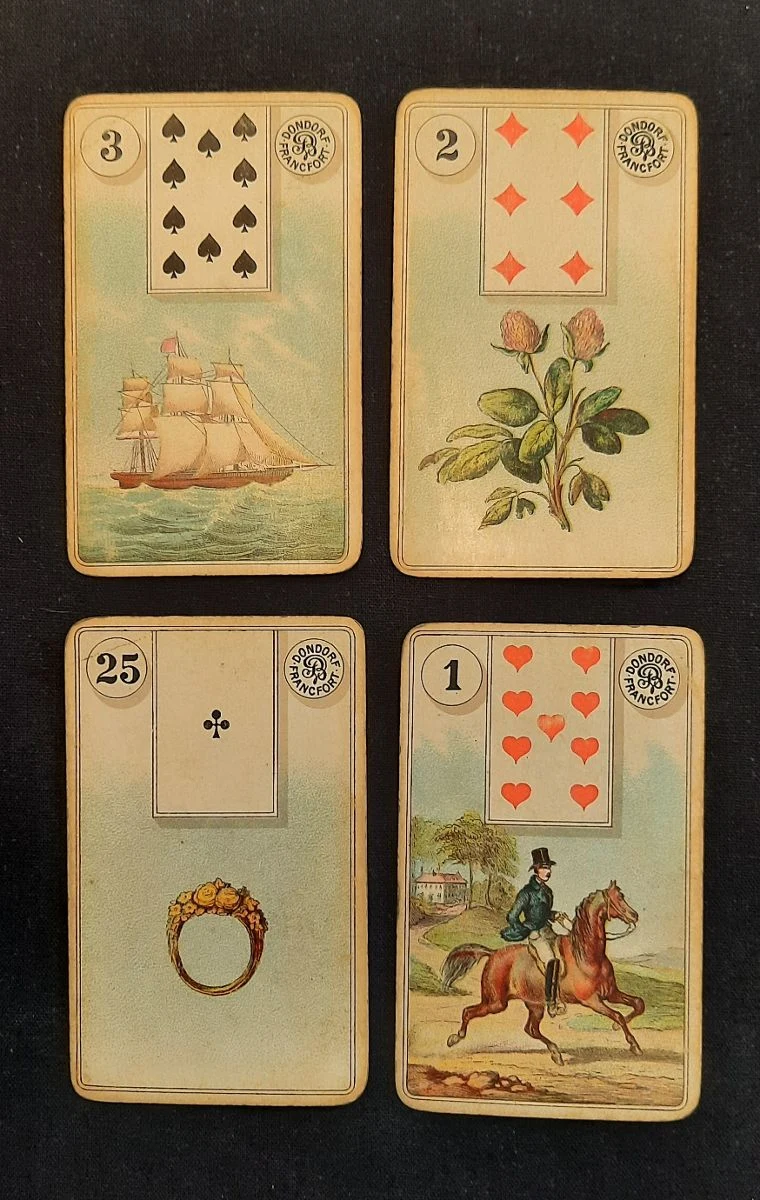
Stadtmuseum Einbeck, SME A 10184, via Kulturerbe Niedersachsen · CC BY-SA 4.0. Complete photograph, unaltered.
Brepols, 1910–1930
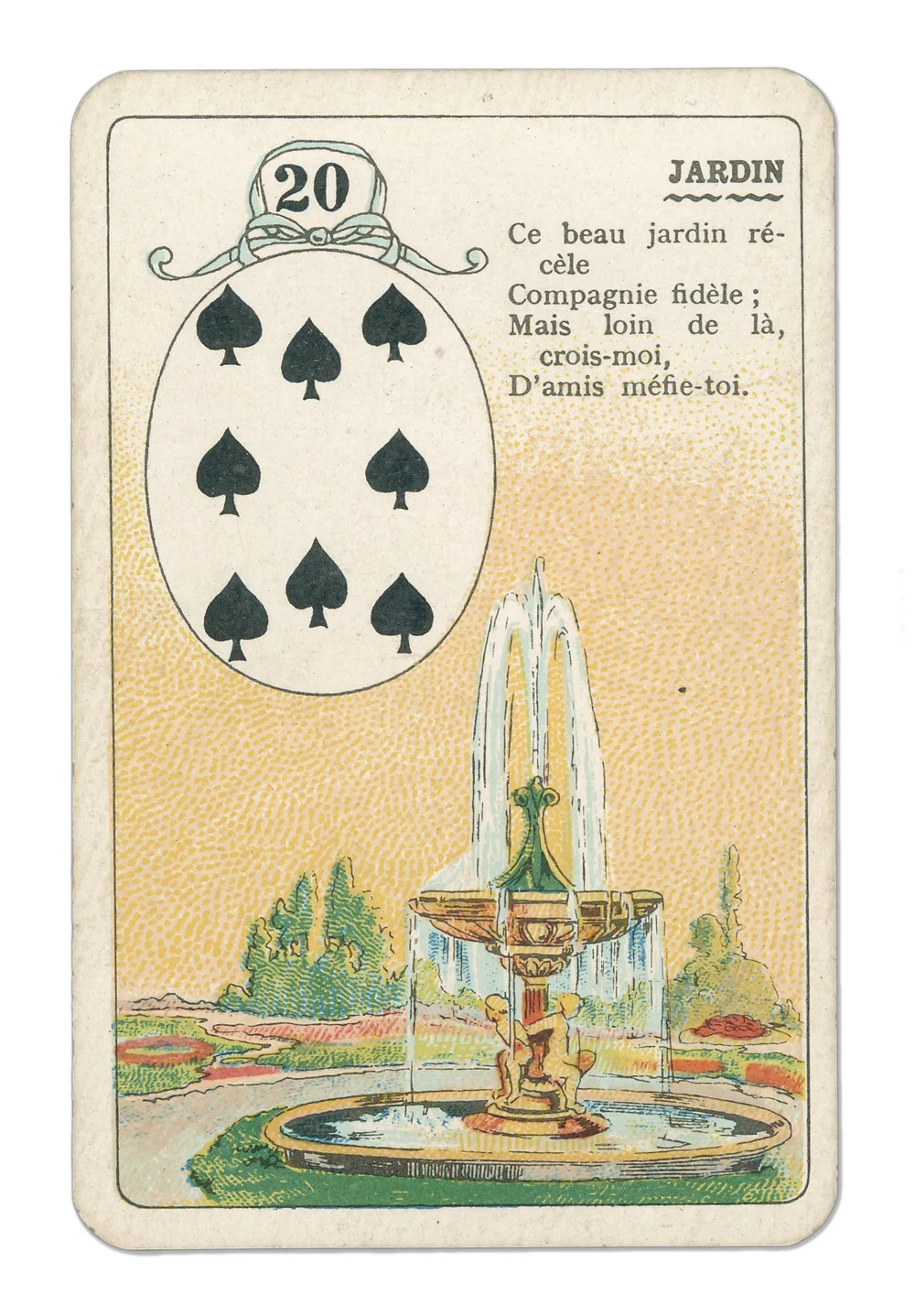
MAS, Antwerp, VM.1990.008.002 ; photograph distributed by the City of Antwerp · Public domain (PDM). Reduced in size, without cropping.
Lenormand today: a deck that keeps finding readers
Reprints, new artwork, books, videos and reader communities now offer many ways to encounter Lenormand. Methods travel more easily between languages, while digitised collections let us compare old booklets with recent presentations.
What I enjoy about this circulation is that it holds two kinds of curiosity together. We can learn to read the cards and ask how their explanations reached us. A new interpretation can be fruitful without needing to be attributed to Hechtel or Mademoiselle Lenormand.
The Grand Tableau as practised today is part of this continuing history. Knowing its age and transformations takes nothing away from the pleasure of exploring it. It simply helps us recognise what is handed down, what changes and what an author proposes in their own name.
What the archives illuminate—and leave open
The main lines are clear: a German repertoire in the late 1790s, a surviving game combining a track and fortune-telling, and marketing under Lenormand’s name after 1843. The Koblenz notices make that last transition more tangible, down to the division of work between a lithographic establishment and its distributors.
Questions remain open. What exactly was the first Game of Hope edition? Was its oracular paragraph identical to the surviving later edition? Which coffee and emblem sources did Hechtel know? How do the earliest Chator and Philippe leaflets relate to one another?
Some located archives invite a separate investigation. The Orne departmental archives list manuscripts under reference 1 J 145, described as Lenormand correspondence and a tarot method. The inventory locates them; it does not let us narrate their contents as though we had read the manuscripts.16
This way of looking enriches Lenormand’s history. It brings us closer to printed cards, sold boxes and transmitted explanations. You can then return to the thirty-six cards in its repertoire with that history in mind. Behind their familiar pictures, printers, players, fortune-tellers and generations of readers cross paths.
Timeline: distinguishing evidence, objects and stories
- Etteilla’s book
A cartomancy publication predating Lenormand.
Publication - Marie-Anne-Adélaïde Lenormand
Generally accepted lifespan; older sources dispute the birth year.
Biographical reference points - Les Amusements des Allemands
Claimed Viennese antecedent / identified London edition.
Claimed / identified - Game of Hope, Hechtel, Bieling
1798 evidence reported; 1799 advertisement checked.
1799 advertisement checked - British Museum 1896,0501.495
Date of the surviving later edition, not of the first conception.
Object dating - Lenormand’s books
Publications contributing to her reputation.
Publications - Statement in the Gazette des tribunaux
Lenormand denies having trained pupils.
Statement - Lenormand’s death
A reference point for understanding posthumous claims.
Biographical reference point - Koblenz advertisements
Documents identified by Rotti; printed extracts examined.
Fragments examined - Second / fourth edition announced
Thirty-six cards; distributor and lithographic establishment specified.
Announced editions - McLoughlin, New York
Penn Museum set, with instructions.
Object dating - Geûens-Seaux, Bruges
Petit Lenormand described by the BnF.
Object dating - Brepols, Garden card
Belgian example held by the MAS.
Object dating - Varied editions and media
A continuing transmission; no overall numerical measure is claimed here.
Present-day transmission
Notes, sources and further reading
1Hechtel’s dates and the 1798 evidence are discussed in Lothar Teikemeier’s research and the record for the annotated reprint of the 1798 collection. Scans of Humoristische Blätter, first quarter of 1799, were examined directly: title page and advertising supplement, image n109, after printed page 102, usually cited as p. 104. The thirty-six-card game is listed under Hechtel at thirty kreuzers; the 1798 collection is separate. Original documents for an offer as early as 1798 remain to be checked.↩
2BnF, Etteilla’s publications ; Tim Husband, tarot history and structure, Metropolitan Museum of Art, 2016. This context does not establish descent from tarot to the thirty-six images.↩
3William G. Pooley, “Paper Tools for Broken Hearts”, French History, 37/4, 2023, pp. 379–400. The academic record and abstract were consulted; no detailed analysis of a court case from this article is reproduced here.↩
4British Museum, 1896,0501.495 ; F. M. O’Donoghue, Catalogue of the Collection of Playing Cards…, 1901, pp. 108–109, German entries 192–193, digitised text consulted. Current record known through indexing; direct access was blocked.↩
5German transcription of the leaflet, pp. 1–4; Marcus Katz and Tali Goodwin, Learning Lenormand: Traditional Fortune Telling for Modern Life, Llewellyn Publications, first electronic edition, 2013 (ISBN 9780738736877), appendix 1, “The Game of Hope”, translated by Steph Myriel Es-Tragon. The text states that it is a second, improved edition. Caitlín Matthews, The Complete Lenormand Oracle Handbook: Reading the Language and Symbols of the Cards, Destiny Books / Inner Traditions, 2014 digital edition (ISBN 9781620553268), introduction, “Petit Lenormand Cards and Their Origins”, presents a 6 × 6 oracle; note 5 of her introduction refers to Ronald Decker, Thierry Depaulis and Michael Dummett, A Wicked Pack of Cards: The Origins of the Occult Tarot, Duckworth, 1996, p. 141, not consulted directly here. Translation and transcription agree on 8 + 8 + 8 + 8 + 4 for the surviving example; its complete facsimile was not checked.↩
6Mary K. Greer, “A New Lenormand Deck Discovery”, 12 July 2013; transcription of the 1796 booklet ; British Museum, 1982,U.4637.1-32. The table compares motifs from lists; it is not a collation of all original images.↩
7Lottery Museum, Venetian Biribissi, c. 1800. Comparisons with emblems and lotteries suggest possible influences; this object establishes no specific borrowing by Hechtel.↩
8BnF, Le Normand authority record and publications ; NLI, Mémoires… Joséphine, 1820 ; Wellcome, Manifeste des dieux, 1832, warning and signature, image 6. Louis Du Bois gives 1768 in his polemical text of 1843, transcribed by Lisieux library. The date 1772 is retained with this discrepancy noted; no claim is made to have checked a birth certificate.↩
9Gazette des tribunaux, 29 November 1838, final page, Lenormand’s statement concerning a supposed pupil. Contemporary source checked; evidence of her public declaration.↩
10Antonella Rotti, study of the Koblenz advertisements, 14 September 2026. The four reproduced extracts of notices 10029, 9074, 1218 and 5728 were examined. Their issue dates are identified by this study; complete SLUB views were technically inaccessible here. 2 December 1845, 5 December, 17 February 1846, 7 August. The earlier 1846 trail is documented in the 2012 research exchanges.↩
11McLoughlin leaflet, two-page scan, contents and signature checked visually; no printed date identified. Penn Museum, 16527A : American set dated 1882–1893. The scan and museum object have not been identified as the same copy.↩
12Rana George, The Essential Lenormand: Your Guide to Precise & Practical Fortunetelling, Llewellyn Publications: first electronic edition, 2014 (ISBN 9780738739717), and second edition, 2025 electronic version (ISBN 9780738780542). Compared passages: introduction, “What Is Lenormand?”, and the “Piquet” glossary entry in both editions. The personal addition of four sixes is explicit in the 2025 passage and absent from the corresponding 2014 passage. Additional locations in the examined digital copies: PDF pages 13–14 and 417 in 2014; 18 and 814 in 2025. These are digital page positions, not printed pagination. Marcus Katz and Tali Goodwin, Learning Lenormand: Traditional Fortune Telling for Modern Life, Llewellyn Publications, first electronic edition, 2013 (ISBN 9780738736877), appendix 2, “The Game of Picket (Piquet)” (additional reference: PDF page 270): a reproduction of thirty-six-card piquet rules whose original historical edition is not identified in the extract.↩
13The BnF catalogue distinguishes, among other categories, divinatory cards and the Grand Jeu de société. For the date 1845, Antonella Rotti’s study cited in note 10, section “The accepted date and its source”, locates the statement precisely in Detlef Hoffmann and Erika Kroppenstedt, Wahrsagekarten. Ein Beitrag zur Geschichte des Okkultismus, Deutsches Spielkarten-Museum, Bielefeld, 1972, p. 17, catalogue object 15: this concerns the Grand Jeu de société. This location is reported by Rotti; the 1972 catalogue was not consulted directly here. It is not used to date the Petit Lenormand or identify a first thirty-six-card edition.↩
14For contemporary practice: Caitlín Matthews, work and edition in note 5, part II, “The Playing Card Insets”, and part III, “The Art of the Grand Tableau”; Rana George, work and editions in note 12, part 3, “Reading Techniques and Spreads”. Alexandre Musruck, Le guide des associations du Petit Lenormand, Éditions Arcana Sacra / Améthyste Éditions, French edition, 2019 (ISBN 9791094878262), introduction and “Les associations ou l’art de lire les paires”. Lisa Young-Sutton, The Petit Lenormand Oracle: A Comprehensive Manual for the 21st Century Card Reader, BookBaby, digital edition with 2021 copyright (ISBN 9781098359713), “Playing Card Insets”, “How can we use the insets?” and “Grand Tableau (GT) Steps”; BookBaby listing. Eron Mazza, The Living Lenormand: Reading & Magic with the Cards, Crossed Crow Books, 2025 edition (print ISBN 9781964537498), introduction, “How I Discovered the Cards”, and chapter 1, “A History of Lenormand”. Selected passages of these works were consulted; they document contemporary practice and narratives, not archives from Hechtel’s time.↩
15Stadtmuseum Einbeck, Dondorf, SME A 10184 ; BnF, Geûens-Seaux, FRBNF40918408 ; MAS, Brepols, VM.1990.008.002. Einbeck’s date remains a broad museum estimate. Reproduction licences appear beneath the images and in the image provenance register.↩
16Orne departmental archives, series J inventory, reference 1 J 145. Inventory consulted; manuscripts not consulted.↩