What is Lenormand?
A house, a tree, a letter, a heart. Look at a Lenormand deck and almost everything feels familiar. A dog needs little explanation; a path dividing in two already gives you something to think about. Place two cards together, though, and those simple pictures begin to tell a subtler story. They respond to one another, like words in a language. What do they say together?
Lenormand is a 36-card oracle used in cartomancy, the practice of reading cards for divination. Its familiar symbols are read chiefly in combination: one image qualifies another, and meaning emerges from the way they meet.
That is where my fascination with this deck begins. The pictures are easy to recognise, yet they can take you a long way. Two cards are enough to discover the pleasure of reading a pair. The entire deck, laid out as a Grand Tableau, lets you explore connections between different areas of life.
In this article · 11 steps
- What exactly is Lenormand?
- What do the 36 cards look like?
- How does Lenormand work?
- Where did Lenormand come from? A surprising history
- Who was Mademoiselle Lenormand?
- How is it different from tarot?
- Petit Lenormand, Grand Lenormand and Grand Tableau: what is the difference?
- How to start learning Lenormand
- Why Lenormand means so much to me
- Questions you may have at the beginning
- Why not start with two cards?
What exactly is Lenormand?
Lenormand has a set of symbols that carries across decks: Rider, Clover, Ship, House… all the way to Cross. Each card has a number and a place in that sequence. Rider is 1; Heart is 24; Ring is 25.
That continuity matters. Open a book, watch a demonstration or try another edition: beneath a different drawing, the same reference points are there. A watercolour and an old engraving can speak the same language.
Lenormand is called an oracle. It has its own structure, distinct from tarot, and a reading tradition in which the cards speak to one another.
The deck can address everyday subjects: a relationship, an exchange, a commitment, a project, home life. Letter draws attention to communication; Mountain may suggest resistance or delay. Together, the cards clarify both the subject and the relationships between its different elements.
You begin with things you know. Learning gives them nuance. Dog may suggest friendship or loyalty; the cards around it help you understand which bond is at stake. Little by little, a familiar picture becomes a card you know how to read.
What do the 36 cards look like?
The deck brings together people, animals, places, objects and natural elements. You will find Fox, Book, Clouds and Fish. The main image usually remains easy to identify, even in richly detailed artwork.
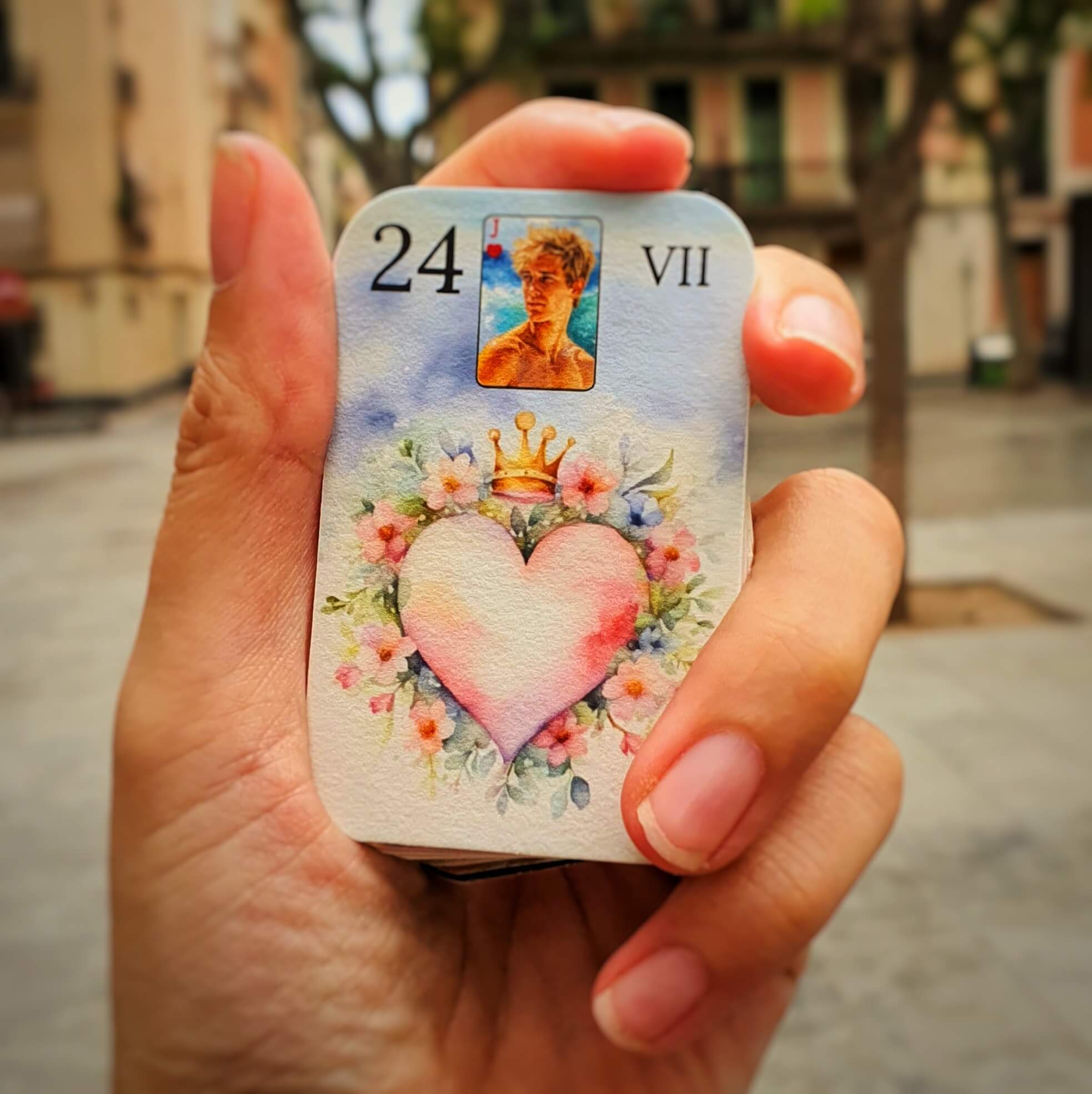
In many editions, three elements share the card: its number, its main image and a small playing card. That smaller image is called a playing-card inset. It recalls the deck’s historical connections with European playing cards. Some methods make extensive use of the insets. When you are starting out, you can learn the main symbols first and return to them later.
Take Book. You recognise the object and may already think of knowledge, study or something discovered by opening its pages. Yet the deck also carries meanings that cannot all be guessed from the picture. That mixture of recognition and discovery keeps drawing you back.
Classic deck
Isabelle’s Aquarelle deck
Explore Isabelle’s deck
Details in an illustration may catch your eye, but they do not replace the card’s meaning. The colour of a ribbon or an artist’s choice of setting does not, by itself, rewrite the whole vocabulary. Shared reference points leave plenty of room to enjoy a deck you love looking at.
When choosing your first deck, look at how clearly the symbols and numbers read, as well as the card size. Large cards can be beautiful, but they take up considerable space when you lay out the whole deck. For a Grand Tableau, your table size eventually has a say.
Some editions include extra cards or alternative person cards. A deck that retains the core set will make it easier to follow explanations. Explore the symbols and their nuances in the encyclopaedia of all 36 Lenormand cards.
Thirty-six pictures to get to know
How does Lenormand work?
The cards speak to one another
Heart speaks of feelings, affection and what we love. Ring suggests a bond, a commitment, a contract or something recurring. Separately, each opens several possibilities. Side by side, they begin to address the same subject.
The idea of a language helps here. A single word suggests something; another makes it more precise. With Lenormand, you learn to move from separate images to a sentence. You may recognise every card in a spread before you know how to connect them. That is a normal stage, and just two cards can help you feel the difference.
Your question helps you find the right angle. In a work reading, you might consider what the cards say about a project or professional commitment. In a relationship reading, bonds and feelings come into focus. Meanings become clearer as you establish what you are talking about.
Heart + Ring: feelings with a commitment
Feelings + commitment
Heart and Ring qualify each other.The question gives the reading its focus.
Imagine asking about a relationship and drawing Heart + Ring. Heart brings affection; Ring gives it the shape of a bond or commitment. A first reading might be: “feelings finding a place in a committed relationship”.
Now ask something different of the same pair: “How should I approach this collaboration?” Ring still suggests commitment, while Heart may point to enjoyment and sincere interest in the project. You might read an agreement you are happy to invest yourself in.
The cards have not changed; the question offers a different angle. These two imagined readings show how a combination can carry more than one nuance.
To continue learning, explore Lenormand card combinations. Examples become more useful when you take time to see how they work. Try reading the pair yourself first, then discover other possibilities.
When you add more cards
A line of three or five cards gives you more connections to explore: an exchange, a movement, the elements at play in a situation. The challenge is to form a coherent reading. A string of keywords can become hard to follow, even when each one seems right.
In a Grand Tableau, every card is on the table. You can examine what surrounds a person card, bring several subjects together and see how one question touches another. Different methods work with neighbouring cards, distances and positions.
The different types of spread let you explore the deck on different scales.
Where did Lenormand come from? A surprising history
The name points towards a French fortune-teller. The images take us to Nuremberg, around 1799–1800, and a German game associated with Johann Kaspar Hechtel: Das Spiel der Hoffnung, the Game of Hope, published by G. P. J. Bieling.
The Game of Hope
Copy held by the British Museum
The cards formed a board. Arranged in sequence, they made a track along which players moved by rolling dice. Some spaces sent you forward; others held you back or made you retrace your steps. Anchor, number 35, was the favourable destination. The pictures already shaped what happened during play.
The instructions also offered an oracular pastime: shuffle the cards, lay them out and tell a story from the images surrounding a person card. The possibility of reading the cards was already part of the board game.
The British Museum holds a later edition of the Game of Hope, dated to approximately 1800–1850. That date describes the surviving copy; the game’s beginnings are placed earlier, around 1799–1800. Its sequence of images and numbers is the one from which today’s Lenormand descends.
These cards served several purposes, and their divinatory use developed and passed from reader to reader over time. Their symbols also belong to an older European repertoire of pictures, games and practices. There are many avenues to explore; the origin of every motif is not fully known.
One question remains: how did a Frenchwoman’s name become attached to the descendant of a German game?
Who was Mademoiselle Lenormand?
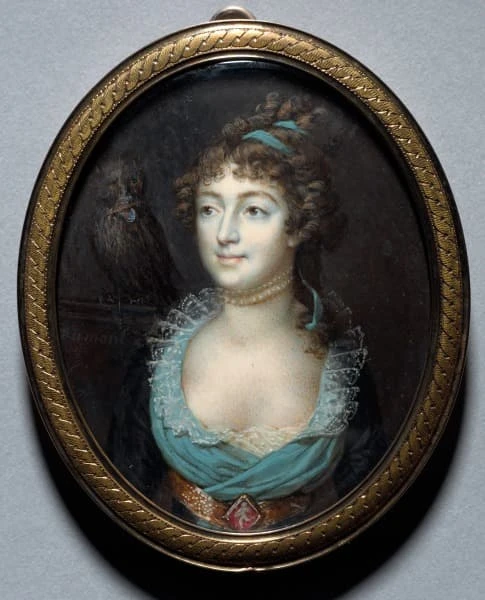
Cleveland Museum of Art, 1921.911. Gift from J. H. Wade. CC0.
Marie-Anne-Adélaïde Lenormand, also known as Le Normand, lived from 1772 to 1843. A celebrated Parisian fortune-teller, she lived through political upheaval, from the French Revolution through the regimes that followed. She was also an author, and her publications did much to build her reputation.
The works listed in the Bibliothèque nationale de France catalogue give a sense of this. Their titles bring together prophetic memoirs, political events and contemporary figures. Here is a woman whose reputation was built through books as well as consultations.
Joséphine and Napoleon often appear in accounts of her life. Some anecdotes were repeated long after the events. They are part of her legend; each would need its own evidence before being treated as established fact.
After her death, manufacturers used her name to market divinatory decks. That is where her story meets the history of these cards. Mademoiselle Lenormand did not create the 36-card system that now bears her name. Her fame gave it an enduring identity.
There are two threads to follow: a French fortune-teller and a game of German origin. Our article on the history of Lenormand follows them further through surviving objects and questions that remain open.
How is it different from tarot?
A full tarot deck generally has 78 cards : 22 Major Arcana and 56 Minor Arcana divided into four suits. Lenormand has a different set of symbols and a different organisation. You are learning two systems, even where some pictures look similar.
In tarot, figures, numbers, suits and scenes offer many ways into a reading. This varies with the deck: Tarot de Marseille and Rider–Waite–Smith do not illustrate their numbered cards in the same way. In Lenormand, the relationships between familiar symbols play a particularly prominent role.
Both can address everyday life and human dynamics. Tarot readers also combine cards; Lenormand readers also explore feelings and attitudes. Learning means discovering how each system organises those possibilities.
If you already read tarot, your listening skills and experience come with you. You still need to get to know Lenormand’s vocabulary. Tower, for instance, belongs to its own system: immediately assigning it the meaning of tarot’s Tower would blur that first encounter.
Our comparison, Lenormand or tarot: what is the difference, and which should you choose? explores these differences and offers pointers for choosing where to begin.
Petit Lenormand, Grand Lenormand and Grand Tableau: what is the difference?
The names can be confusing when you are choosing a deck or a book. These are the three distinctions to keep in mind.
The Lenormand is the deck we are exploring here. The Grand Lenormand is a different deck, traditionally comprising 54 cards. Its images bring together several scenes and correspondences, including mythological ones. A BnF record describes a 54-card edition of the Grand Jeu.
“Grand” does not mean an advanced stage to move on to after “Petit”. Each deck has its own methods. Before buying, check the images and the number of cards: it will be easier to find the right learning resources.
The Grand Tableau, meanwhile, is a spread using every Lenormand card. The entire deck is laid out so you can read its relationships. You can learn Lenormand and then try a Grand Tableau without ever needing a Grand Lenormand deck.
The whole deck at a glance
You can find an introduction on the Grand Tableau page. Take a moment to look at the layout, even if you do not yet know the meanings. Seeing the cards together already gives you a sense of what you might explore.
How to start learning Lenormand
Get to know a few cards
Start with a small group rather than every nuance of the deck. Keep two or three central ideas for each card, then look for everyday examples. Letter suggests writing or communication; Book suggests knowledge or something not yet known. Examples make that distinction easier to remember.
At first, use one book or main resource as your reference. Authors do not always give exactly the same meanings or weight to each technique. You can compare their approaches once you know the deck better.
Then put two cards together and look for a simple sentence. You are allowed to hesitate, check the guidebook and wonder which meaning fits best.
Try a pair during the day
For a first exercise, ask: “What aspect of my interactions could I pay attention to today?” Draw two cards and note what they suggest before getting on with your day. One or two sentences are enough. You do not need to fill a page to begin reading.
In the evening, return to your notes. Did an idea echo something you experienced? Does another still puzzle you? Some days the connection will feel meaningful; on others you may not know what to make of it. Keep those notes too: they give you an honest record of your learning.
If you cannot remember exactly what you wrote before events unfolded, it is easy to adjust a reading afterwards. A notebook lets you recover your first thoughts, including those that surprise you or no longer convince you.
Keep a notebook you enjoy returning to
The date, your question, the cards and your first reading are a good start. Add a few observations later. Your notebook can stay very simple; what matters is being able to revisit what you tried.
Over time, you will notice which cards you confuse, which combinations become familiar and which questions help you read. You can revisit a pair that once left you uncertain and see whether you understand it differently now.
As pairs become more familiar, try a line of three and discover how a reading takes shape. If the Grand Tableau already appeals to you, hold on to that curiosity. It can give your learning direction even when you begin with only two cards.
Why Lenormand means so much to me
Before I discovered Lenormand, I was already an experienced tarot reader, comfortable with complex readings and larger spreads. Then, by chance, I came across a YouTube video showing a Grand Tableau.
All 36 cards were laid out on the table.
The entire deck, there at a glance. It was a revelation. With tarot, I was not used to laying out all 78 cards that way. What moved me was the possibility of looking at a whole deck: exploring different areas of life together, their relationships, and what strengthens or changes when they meet.
Work, relationships, home, projects: we often treat them as separate subjects, though they meet in life. A career change can alter the balance at home; an emotional bond can shape a decision. The Grand Tableau lets you explore those interactions, seeing where subjects cross and how they respond to one another.
That view of the whole was my first fascination. The second came with learning the language: the subtlety you can reach by knowing the cards, their combinations and the mechanics of a reading.
One symbol takes on a nuance beside another. Its position draws attention to a connection. As you learn to look, you gain more reference points for understanding what is taking shape in a spread. I still find it fascinating to watch a reading grow more precise through those connections.
Intuition works with that knowledge. It helps you perceive a relationship and notice what stands out in the whole. Technique supports your eye; your eye brings sensitivity to the reading. I love that meeting between what we learn and what we perceive.
The Grand Tableau showed me Lenormand’s breadth. Learning its language revealed its precision.
Those are the two dimensions I hope to share here: the desire to look at the whole tableau, and the pleasure of understanding what happens between just a few cards. You can begin with either. They come together as you learn.
Questions you may have at the beginning
Is Lenormand tarot or an oracle?
It is an oracle. “Lenormand tarot” appears in searches and some product names, but Lenormand has its own structure. If you want a deck that fits this site’s explanations, look for the familiar symbols and the 36-card set.
Can I start if I have never read cards?
Yes. You can learn Lenormand directly, without learning tarot first. The familiar pictures make the first steps approachable; a guidebook, a few card references and small spreads will help you explore their meanings.
Do I need a special gift or intuition?
You can start with curiosity. Learning the cards and practising helps you notice their relationships. You do not have to prove anything before taking an interest. Intuition has a place in reading and can develop alongside that learning.
Does Lenormand predict the future with certainty?
Lenormand belongs to a divinatory tradition, and many people use it to explore the future. A reading remains an interpretation, not a guarantee that an event will happen. A precise language does not make the future certain; it helps you express a reading more clearly. Your judgement and freedom to act remain your own.
How many cards should I draw?
Two are enough to practise a combination. You can move on to three, five or other formats. The Grand Tableau uses the entire deck. Choose a spread that suits your question and lets you enjoy learning.
Why not start with two cards?
Return to Heart and Ring, or choose two symbols from the encyclopaedia. Look at what each contributes and try bringing them together in a sentence. You may want to open a card guide, compare another pair or ask a more precise question.
That is a good place to start: something simple enough to try, with a curiosity that leads you further. Here you will find the cards to explore and their combinations. Return to them with the questions that arise as you practise.
Two cards to enter the language; the whole deck to explore its wider connections. Lenormand has room for both impulses. I hope you enjoy getting to know it, and returning with questions of your own.