Lenormand or tarot: what is the difference, and which should you choose?
I was already an experienced tarot reader, working with complex spreads, when I discovered Lenormand. What I love about it is how directly it invites you into a reading: House, Dog and Letter immediately offer something recognisable. If you are new to card reading and undecided between the two, I recommend starting with Lenormand.
Lenormand is a 36-card system whose symbols are read in combination. A complete tarot deck has 78 cards, organised into Major and Minor Arcana. They are two distinct languages. I find the first easier to approach; in my practice, tarot often involves more complex interpretation.
To see what that changes, we will ask both decks the same question: “How should I approach this offer of collaboration?” I will show you what each card contributes and how the whole reading takes shape. You can follow both examples step by step, even if you do not own a deck yet.
In this article Explore the steps
Two decks, two structures
Lenormand: a vocabulary of 36 symbols
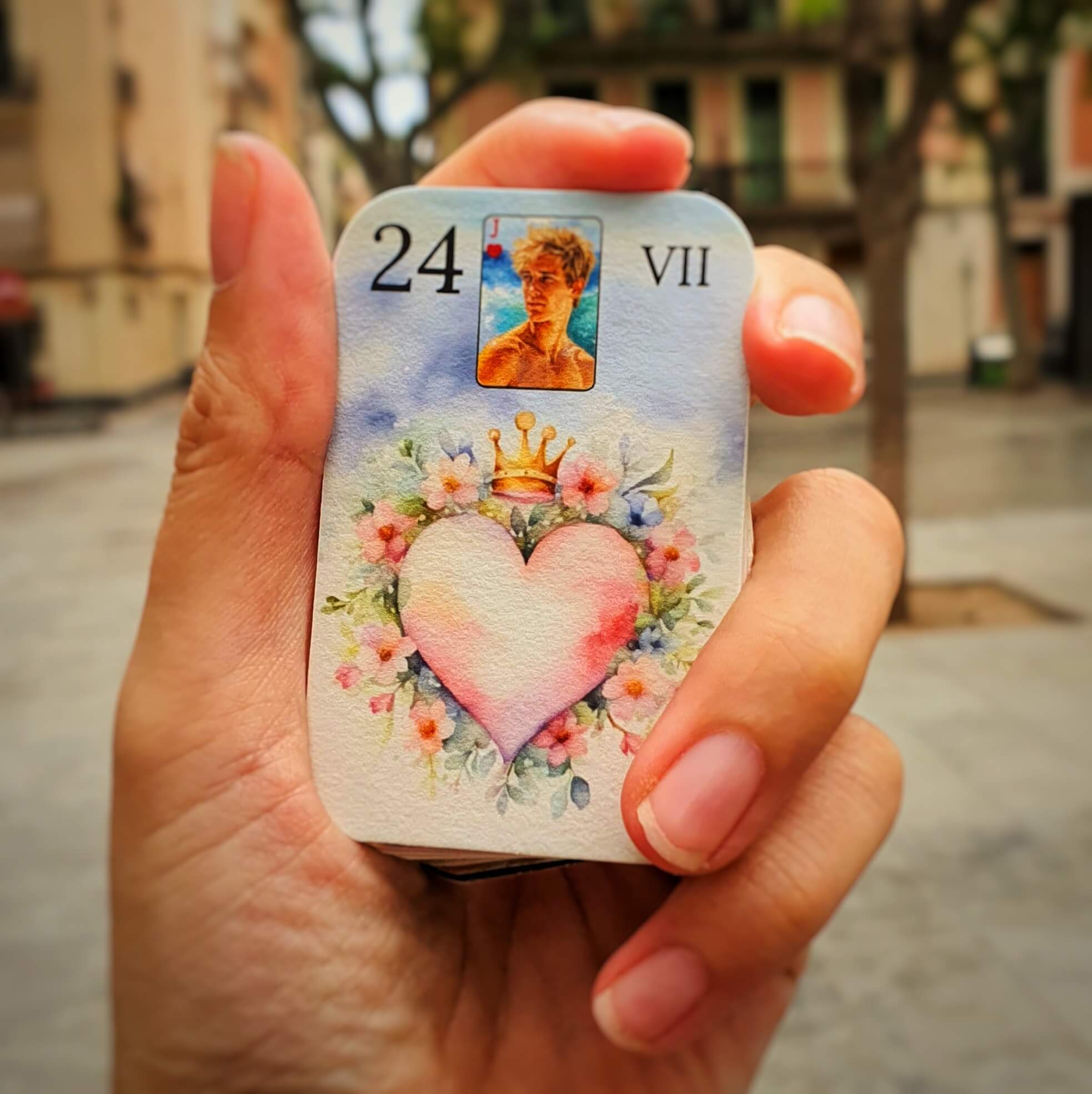
A traditional Lenormand deck contains 36 numbered cards, from Rider to Cross. House, Dog, Letter, Key: their subjects remain recognisable from one edition to another, even when the artwork changes.
These cards are not divided into Major and Minor Arcana. Many also carry a small image of an ordinary playing card, known as a playing-card inset. Some methods use it; others focus mainly on the central symbol. In our example, we will work with symbols and their combinations.
For me, this is a real advantage when starting out. House, Dog or Letter immediately gives you something to recognise. With a few keywords, you can try a combination and then a short sentence. You learn to make familiar pictures more precise. The36-card encyclopaedia lets you explore this vocabulary gradually.
Tarot: suits, numbers and court cards
A complete traditional tarot deck has 78 cards: 22 Major Arcana and 56 Minor Arcana. The Minor Arcana form four suits of fourteen cards, each with ten numbered cards, Ace to Ten, and four court cards, such as Page and Queen. Suit and court names vary between traditions: Cups, Coins, Swords and Batons are common equivalents of the French suit names.
These groups provide reference points. A card belongs to a suit, carries a number or depicts a court figure; each Major Arcana card has its own place and imagery. You can read with the Majors alone, but they are only part of the full deck.
The learning difference is about more than 36 versus 78 cards. Lenormand feels more accessible to me because simple words and their combinations offer a starting point. With tarot, interpretation often feels more complex: several structures and layers of meaning meet in a reading. That is part of its appeal too.
Symbols, scenes and pictures: what are we looking at?
With Lenormand’s Letter, you first recognise an object. It opens up the field of messages, documents and written exchanges. The artwork can enrich your observation, but a red envelope does not automatically mean a declaration of love. The question and neighbouring cards clarify what kind of writing is involved.
In a Rider–Waite–Smith-style tarot, the Minor Arcana show scenes. Three of Pentacles, for example, depicts a craftsperson with two other figures inside a building. You can observe their gestures, relationships and surroundings, then connect them with the card’s meaning and its place in the spread.
Not every tarot follows that visual model. In Tarot de Marseille, the numbered cards from Ace to Ten mainly show arrangements of cups, coins, swords or batons: the four suit signs. Numbers, shapes, colours and structures play different roles depending on the method.
Choosing a tarot also means choosing a tradition of images and reading. The Arcana, numbers, court figures and their relationships take time to become familiar. In my experience, sensitivity and an understanding of human behaviour enrich this work. Life experience can give new depth to a card you thought you knew. You can of course learn tarot when you are young: experience grows along the way too.
With Lenormand, I enjoy the direct move from a symbol to what it might stand for: a place, an object, a person, a process or a situation. That accessibility does not confine a card to one definition. Tower, for instance, can speak of an institution or isolation. It has a language of its own, distinct from tarot’s Tower.
How does a reading take shape?
In Lenormand, the meeting of cards is fundamental. Letter and Ring may point to a commitment put in writing. Ring qualifies Letter; Letter gives a form to the commitment. We begin to build an expression instead of placing two definitions side by side.
Depending on the method and spread, order, direction, distance or position may matter. You need to know which conventions you are using. For our three-card line, we will read left to right and connect neighbouring cards. This is a clear teaching convention, not a rule covering every Lenormand reading.
In tarot, a card can be understood through its suit, number, image, neighbouring cards and the role of its position. Justice in “what needs attention” invites you to examine certain points; the same card in “what supports the project” would be approached differently.
Tarot also uses combinations, and Lenormand can use positions. The difference here is what we put to work first: building an expression with Lenormand; reading tarot cards in three stated roles, then connecting them.
In my practice, intuition and technique work together. I want to understand the language of the cards and the methods I use. Intuition enriches that foundation: it helps me notice a relevant relationship, choose a nuance and find the right words. Then try explaining how you reached that meaning. You will see more clearly what you observed, what you know about the cards and what the context helped you clarify.
Can you ask both decks the same questions?
Yes: either deck can address a relationship, work, a choice or a project. For describing everyday situations, though, I have a particular fondness for Lenormand. Its vocabulary names things and clarifies their relationships with a subtlety I love. Tarot can also be concrete or predictive; I simply approach these questions through a different language.
A good question gives the reading something to work with. “How should I approach this offer of collaboration?” identifies both the subject and what you want: a way forward. “Tell me everything about my future” leaves far more room for vagueness, whichever deck you use.
A useful question need not ask for a ready-made decision. “Which aspects of this collaboration should I examine?” invites you to identify things to consider. For this demonstration, we will keep one wording throughout so we can compare approaches without changing the subject.
One Tower, several realities
Card 19 shows Tower. The building is immediately recognisable; what it represents in the question still needs to be understood. Depending on the subject, the same Tower can suggest very different things:
| If the question concerns… | Tower may suggest… |
|---|---|
| A large company | |
| A bank | |
| An official, stable relationship | |
| Isolation | |
| A tall cabinet |
Final row: a contextual application, not a universal traditional meaning.
The tall cabinet is a contextual application: its shape echoes Tower’s vertical form. The other rows illustrate an institutional setting, official status or isolation. One image offers very different footholds without losing all coherence.
The question guides the choice; neighbouring cards refine it. Let us build a combination. In a question about procedures, Tower + Letter may suggest a written communication from an institution. Letter provides the writing; Tower provides the institutional setting. Whether that means a bank or a public office still depends on context or other clues in the spread.
This descriptive richness is what I enjoy: the same symbol can refer to an organisation, a relationship status or a piece of furniture, provided we can explain why we chose that meaning. Find more guidance in the Tower card guide.
Short spreads and the Grand Tableau: what experience are you looking for?
A few cards are enough to begin observing relationships. In Lenormand, two or three already let you practise a combination. In tarot, one or three can help you explore a question using chosen positions or another clearly stated convention.
Lenormand also has a particularly fascinating format: the Grand Tableau, which lays out all 36 cards. It lets you explore several areas of life and the relationships running through them. Depending on the method, proximity, direction or houses—positions with fixed reference meanings—contribute to the reading.
Seeing the whole deck laid out was my first fascination with Lenormand: the way areas of life answered one another within a single picture. Then the subtlety of its language made me want to go further.
You can love that overview and still begin with short lines. The Grand Tableau is something to work towards; it does not require you to lay out 36 cards on your first evening. Nor does a 78-card tarot demand an enormous spread. The format should remain readable for the person using it.
One question, two readings, step by step
“How should I approach this offer of collaboration?”
The following spreads are fictional teaching examples. We know nothing about an actual contract, partner or outcome. We will follow what each card contributes without filling in those gaps for it.
Lenormand: Letter + Ring + Crossroads
Classic cards: edition and publication rights still to be confirmed. Select a card to view it in full.
1. Identify the vocabulary. The Letter, 27, brings writing: a message, document or formalised exchange.Ring, 25, brings a bond and commitment: an agreement, partnership or possibly a contract, depending on context. Crossroads, 22, brings options, alternatives and a decision to make. Here we are reading the symbols; we are not using the little verses or playing-card insets printed on the reproduced cards.
2. Connect Letter + Ring. In a question about collaboration, writing meets commitment. We might say: a written agreement or a document concerning a commitment. Which nuance fits depends on what the person already knows: have they received an informal message or a draft contract?
3. Connect Ring + Crossroads. Commitment meets several possible routes. The connection might become: a choice concerning the agreement, or several ways of committing to examine. Crossroads does not tell us what the options are. It draws attention to their presence or to a decision that needs clarifying.
4. Read the line in order. With our chosen convention, we move from writing to commitment and then to options. The line invites us to examine what the written proposal commits us to and which choices it leaves open. Order gives the reading a progression; it does not provide a timetable of events here.
To feel the difference, imagine Crossroads + Letter + Ring: attention would begin with options, then their written expression within an agreement. The starting point has changed, and so has our sentence.
5. Build the answer. The question asks how to approach the offer, so we turn our expression into a possible course of action. One synthesis would be: “Clarify the terms of the commitment in writing, along with the options you need to choose between.” Writing comes from Letter; the terms of commitment come from its link with Ring; options come from Crossroads.
If there is a draft contract, this may invite you to compare its proposed terms. If the collaboration has only been mentioned in a message, the first task may be to spell out the expected commitment. The same combination becomes more precise in two possible contexts.
Tarot: Three of Pentacles + Justice + Two of Wands
Waite–Smith, “Roses & Lilies”, 1909 according to the Commons records. Pamela Colman Smith. Scans attributed to Saskia Jansen. The records identify them as public domain. All three reproductions come from the same set.
Here we are using a Rider–Waite–Smithtarot, with upright cards. Three positions are defined before reading: what supports the collaboration; what needs attention; a possible direction.
1. Three of Pentacles: what supports the collaboration. A craftsperson works inside a building; two other figures stand nearby, one holding a document. The scene brings together work, skills and a discussion about putting them into practice.
In the support position, we read cooperation between complementary skills. The practical question becomes: what does each person bring to the project? Liking the idea of collaboration is not enough; we need to name the contributions. That question follows from the chosen meaning and the supportive role of the position.
2. Justice: what needs attention. The scales and sword draw our eye towards balance, discernment and decision. Here, Justice asks us to examine the clarity and fairness of the framework: responsibilities, commitments and how expectations are shared.
The “attention” position matters. It does not prove anyone is dishonest. It asks: is the framework clear and balanced enough? In a support position, we would instead ask how a fair framework already helps the collaboration. Same card, a different role in the reasoning.
3. Two of Wands: a possible direction. A figure holds a globe and looks beyond a wall. We focus here on perspective and the direction being considered. In this position, the card invites you to look beyond the immediate opportunity: where would you like this collaboration to take you?
The globe does not let us assert that the project will be international. We use the image to illuminate a direction in relation to the question, without turning every pictured object into a predicted event.
4. Connect the three positions. Complementary skills are a resource to explore; a fair framework needs attention; a chosen direction can guide what comes next. The answer becomes: “Identify what each person brings, examine the balance of the agreement and check that the project serves the direction you want to take.”
Three of Pentacles and Justice speak to each other: working together also means understanding how contributions are recognised and organised. Two of Wands then opens the perspective. We have connected the cards while preserving each position’s particular role.
What did we do differently?
In the Lenormand line, we began with three areas of vocabulary, then built expressions from neighbouring cards. Letter + Ring clarified the form of the commitment; Ring + Crossroads introduced choice. Our synthesis focused on writing, agreement and options.
In the tarot spread, we first assigned roles to positions. Card images and meanings answered those roles: skills as support, fairness as a point needing attention, perspective as direction. The synthesis connected these three aspects of the project.
The answers meet in the need to examine the agreement. That is natural: we asked the same question. But they did not draw our attention to exactly the same things. Lenormand highlighted written terms and choice; tarot highlighted contributions, the framework and the desired direction.
This describes the two examples we have just worked through. Different cards, layouts and methods would produce different reading journeys.
Your turn: no new cards needed
You can use the examples on this page without owning a deck. Choose one synthesis and rewrite it in your own words, in one sentence. Underline each idea and identify the card that contributed it. For tarot, add the role of its position.
If no card explains an idea, ask whether it comes from context or whether you added it. Finally, write a question to ask your prospective partner or yourself before agreeing: “What responsibilities will each of us take on?”, for example. You have done the essential work: making your interpretation understandable and useful without making it longer.
To continue, explore Lenormand combinations. You need not investigate every possible pair tonight. A sentence whose construction you understand is already worth writing down.
Which should you choose as a beginner?
If you are completely new to card reading and want an approachable system, I recommend starting with Lenormand. Its symbols are recognisable; a few keywords give you a first vocabulary, and combinations soon let you build short readings.
Begin with two cards and ask what they express together. Letter brings writing; Ring adds commitment. You already have an expression to examine. That directness explains my preference for Lenormand. With tarot, I often find the interplay of symbolic layers more demanding.
Depth comes with practice: choosing the nuance that fits the question, understanding neighbouring cards, using your method’s conventions and then reading a larger whole. Easier to approach does not mean quickly exhausted. The Grand Tableau offers a wonderful glimpse of what these 36 cards can become when you learn to connect them.
Of course, you can begin with tarot if that is what draws you. Take time to choose a tradition: Rider–Waite–Smith scenes and Marseille arrangements offer different starting points. My advice to an undecided beginner remains Lenormand: its concrete vocabulary lets you get into reading from your very first combinations.
Try writing your own sentence for Letter + Ring + Crossroads. Return a few days later with the same question and see whether you can explain each card’s role more clearly. The spreads page will help you choose a small format to continue. You need not know all 36 cards perfectly before you begin exploring their connections.
Can you learn and practise both?
Yes. You need not master tarot before opening a Lenormand deck, or finish learning Lenormand before approaching tarot. If you begin both, separate sessions or notes can simply help you recognise what you are learning.
Record the question, the deck, your chosen reading method—line order or positional roles—and your synthesis. This helps you avoid unconsciously moving meanings between systems. Lenormand’s Tower and tarot’s Tower can each keep their own place instead of sharing a meaning merely because they look alike.
You can explore a situation with both, provided you know what you want from each reading. Agreement is not independent proof that the future will match the cards; a difference may invite you to examine another aspect. Explaining both answers is more instructive than repeating readings until you get a reassuring one.
I particularly enjoy the subtlety Lenormand offers when intuition rests on a sound knowledge of the cards and their methods. My tarot experience accompanied that discovery. It did not remove the need to learn the new deck’s language.
The differences at a glance
| Reference point | Lenormand | Tarot |
|---|---|---|
| Traditional structure | 36 numbered cards; a stable set of symbols | 78 cards: 22 Major and 56 Minor Arcana; the Minors form four suits |
| What you look at | The symbol and its relationships with other cards | The imagery and structures of your chosen tradition |
| In our demonstration | A line read through combinations, from left to right | Three cards read in defined positions, then connected |
| Possible questions | Often concrete and event-focused; reflection is also possible | Practical, predictive or reflective, depending on the approach |
| Formats | Short lines and larger layouts, including the 36-card Grand Tableau | Short or extended spreads, with or without predefined positions |
| What you learn | Vocabulary, combinations and your method’s conventions | Suits, numbers, court figures, images and your method’s conventions |
| My view for beginners | More approachable through familiar symbols and first combinations | Often more complex interpretation, with several layers of meaning |
Frequently asked questions
Is Lenormand easier than tarot?
In my view, yes, at the beginning. Familiar symbols, keywords and combinations offer a more direct route into first readings. Mastery takes practice: a simple starting point leaves plenty of room for subtlety.
Which is more precise?
For describing the concrete elements of a situation, I find Lenormand especially subtle. Combinations help clarify what we are talking about and how things connect. That descriptive precision does not guarantee an event will happen. I keep that distinction in mind whenever I speak of its precision.
Can I use either for a love question?
Yes. Defining what you want to understand helps more than choosing a deck supposedly “better for love”. Asking how to approach a conversation, for example, creates a different frame from asking how a relationship might develop.
Why do people sometimes say “Lenormand tarot”?
The expression circulates, but Lenormand does not have a tarot’s structure. Check the deck itself: the traditional 36 symbols identify the system discussed here. A product name alone can be misleading.
Why I recommend trying Lenormand
What fascinates me about Lenormand is the precision you can build from such familiar pictures. Letter and Ring offer a first way into the idea of a written agreement. The question, neighbouring cards and reading method then refine it. We can speak about processes, places or relationships with a subtlety I love.
That subtlety requires knowing the cards’ language and mechanics. Intuition draws on those reference points to perceive connections, choose a nuance and refine a reading. That work keeps me learning: understanding a combination, then discovering what another card adds to it.
I recommend starting with Lenormand for this combination of an approachable beginning and a reading practice that grows in depth. Try two cards, find a sentence, then take time to refine it. That pleasure in making a reading more precise lies at the heart of my attachment to these 36 cards.
Continue exploring with two companion articles: What is Lenormand? and The history of Lenormand: from its origins to today.